

Ultimate Guide to Prepare MCD-Level-2 with Accurate PDF Questions [May 10, 2024]
Pass MuleSoft With DumpsValid Exam Dumps
NEW QUESTION # 33
Which statement is true when using XML SDK for creating custom message processors?
- A. All operations are public
- B. An XML SDK provides both inbound and outbound operations
- C. Operations can be reused in recursive calls
- D. Properties are fields defined by an end user of the XML SDK component and serve as a global configuration for the entire Mule project in which they are used
Answer: A
Explanation:
Explanation
When using XML SDK for creating custom message processors, all operations are public by default and can be used by any Mule application that imports them. There is no way to make an operation private or protected in XML SDK. References: https://docs.mulesoft.com/mule-sdk/1.1/xml-sdk#operations
NEW QUESTION # 34
Which plugin or dependency is required to unit test modules created with XML SDK?
- A. XMLUnit
- B. MUnit Extensions Maven plugin
- C. MUnit Maven plugin
- D. Junit
Answer: B
Explanation:
Explanation
To unit test modules created with XML SDK, the developer needs to use the MUnit Extensions Maven plugin.
This plugin allows testing XML SDK modules using MUnit by adding a dependency to the module under test and using a custom processor tag to invoke it. References:
https://docs.mulesoft.com/mule-sdk/1.1/xml-sdk#testing
NEW QUESTION # 35
A company has been using CI/CD. Its developers use Maven to handle build and deployment activities.
What is the correct sequence of activities that takes place during the Maven build and deployment?
- A. Initialize, validate, compute, test, package, verify, install, deploy
- B. Validation, initialize, compile, test, package, install verify, deploy
- C. Validate, initialize, compile, package, test, install, verify, verify, deploy
- D. Validate, initialize, compile, test package, verify, install, deploy
Answer: D
Explanation:
Explanation
The correct sequence of activities that takes place during the Maven build and deployment is validate, initialize, compile, test package, verify, install, deploy. These are Maven lifecycle phases that define a sequence of goals to execute during a build process. Each phase represents a stage in the build lifecycle and can have zero or more goals bound to it. References:
https://maven.apache.org/guides/introduction/introduction-to-the-lifecycle.html
NEW QUESTION # 36
Multiple individual Mute application need to use the Mule Maven plugin to deploy to CloudHub.
The plugin configuration should .. reused where necessary and anything project, specific should be property-based.
Where should the Mule Maven details be configured?
- A. A parent pom.xml
- B. A Bill of Materials (BOM) parent pm
- C. Pom, xml
- D. Settings, xml
Answer: A
Explanation:
Explanation
To reuse Mule Maven plugin configuration across multiple individual Mule applications, the developer should use a parent pom.xml file. A parent pom.xml file defines common configuration for one or more child projects that inherit from it. The developer can specify common properties and dependencies for all child projects in the parent pom.xml file, such as Mule Maven plugin configuration, and then reference them in each child project's pom.xml file using placeholders. References:
https://docs.mulesoft.com/mule-runtime/4.3/mmp-concept#parent-pom
https://maven.apache.org/guides/introduction/introduction-to-the-pom.html#Project_Inheritance
NEW QUESTION # 37
Refer to the exhibit.
A Mute Object Store is configured with an entry TTL of one second and an expiration interval of 30 seconds.
What is the result of the flow if processing between os'store and os:retrieve takes 10 seconds?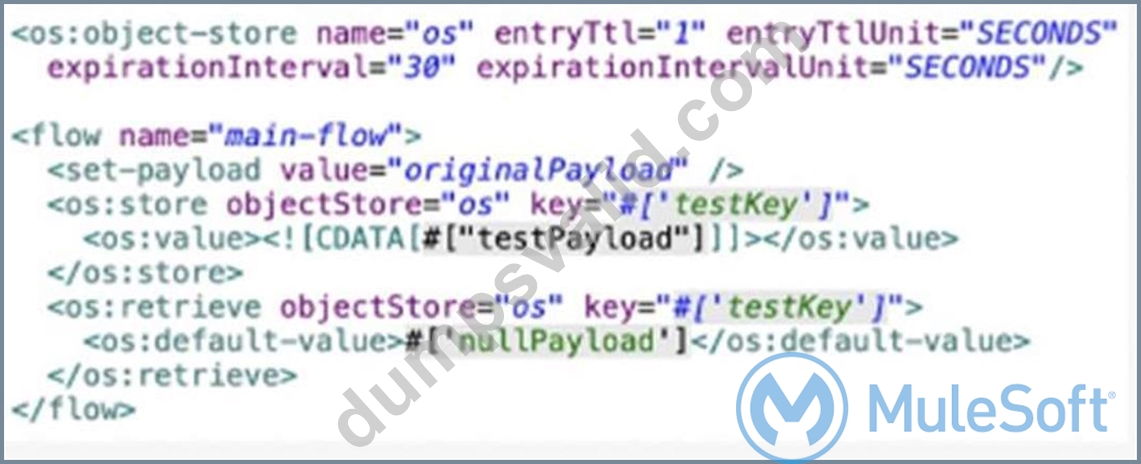
- A. testPayload
- B. nullPayload
- C. OS:KEY_NOT_FOUND
- D. originalPayload
Answer: B
Explanation:
Explanation
The result of the flow is nullPayload if processing between os:store and os:retrieve takes 10 seconds. This is because the entry TTL of the object store is one second, which means that any stored value expires after one second and is removed from the object store. The expiration interval of 30 seconds only determines how often the object store checks for expired values, but it does not affect the TTL. Therefore, when os:retrieve tries to get the value after 10 seconds, it returns nullPayload because the value has already expired and been removed.
References: https://docs.mulesoft.com/object-store/osv2-faq#how-does-the-time-to-live-work
NEW QUESTION # 38
A heathcare customer wants to use hospital system data, which includes code that was developed using legacy tools and methods. The customer has created reusable Java libraries in order to read the data from the system.
What is the most effective way to develop an API retrieve the data from the hospital system?
- A. Create the Java code in your project and invoice the data from the code
- B. Refer to JAR files in the code
- C. Install libraries in a local repository and refer to it in the pm.xml file
- D. Include the libraries writes deploying the code into the runtime
Answer: C
Explanation:
Explanation
To develop an API that retrieves data from a hospital system using reusable Java libraries, the developer should install libraries in a local repository and refer to it in the pom.xml file. This way, the developer can use Maven to manage dependencies and invoke Java code from Mule applications using Java Module operations.
References:
https://docs.mulesoft.com/mule-runtime/4.3/java-module-reference#add-the-java-module-to-your-project
https://docs.mulesoft.com/mule-runtime/4.3/java-module-reference#invoke-java-code
NEW QUESTION # 39
A developer is working on a project that requires encrypting all data before sending it to a backend application. To accomplish this, the developer will use PGP encryption in the Mule 4 Cryptography module.
What is required to encrypt the data before sending it to the backend application?
- A. The application needs the public key from the backend service to encrypt the data
- B. The application needs to both the private and public keys to encrypt the data
- C. The application needs the private key from the backend service to encrypt the data
- D. The application needs to configure HTTPS TLS context information to encrypt the data
Answer: A
Explanation:
Explanation
To encrypt the data before sending it to the backend application using PGP encryption, the application needs the public key from the backend service. PGP encryption uses a public-key cryptography system, which means that each party has a pair of keys: a public key and a private key. The public key is used to encrypt data, and the private key is used to decrypt data. Therefore, to encrypt data for a specific recipient (the backend service), the application needs to use the recipient's public key. The recipient can then use its own private key to decrypt the data. References: https://docs.mulesoft.com/mule-runtime/4.3/cryptography-pgp
NEW QUESTION # 40
When registering a client application with an existing API instance or API Group instance, what is required to manually approve or reject request access?
- A. To configure the SLA tier for the application and have the Exchange Administrator permission
- B. To configure the SLA tier for the application
- C. To configure the SLA tier for the application and have the role of Organization Administrator, API Manager Environment Administrator, or the Manage Contacts permission
- D. To only have Exchange Administrator permission
Answer: C
Explanation:
Explanation
To manually approve or reject request access when registering a client application with an existing API instance or API Group instance, it is required to configure the SLA tier for the application and have one of the following roles or permissions: Organization Administrator, API Manager Environment Administrator, or Manage Contracts permission. These roles or permissions allow managing client applications and contracts in API Manager. References:
https://docs.mulesoft.com/api-manager/2.x/client-applications#managing-client-applications-and-contracts
NEW QUESTION # 41
Which command is used to convert a JKS keystore to PKCS12?
- A. Keytool-importkeystore -srckeystore keystore jks-srcstoretype PKCS12 -destkeystore keystore.p12
-deststoretype JKS - B. Keytool-importkeystore -srckeystore keystore jks-srcstoretype JKS -destkeystore keystore.p13
-deststoretype PKCS12 - C. Keytool-importkeystore -srckeystore keystore p12-srcstoretype JKS -destkeystore keystore.p12
-deststoretype PKCS12 - D. Keytool-importkeystore -srckeystore keystore p12-srcstoretype PKCS12 -destkeystore keystore.jks
-deststoretype JKS
Answer: C
Explanation:
Explanation
To convert a JKS keystore to PKCS12, the developer needs to use the keytool-importkeystore command with the following options: -srckeystore keystore.jks -srcstoretype JKS -destkeystore keystore.p12 -deststoretype PKCS12. This command imports all entries from a source JKS keystore (keystore.jks) into a destination PKCS12 keystore (keystore.p12). References:
https://docs.oracle.com/en/java/javase/11/tools/keytool.html#GUID-5990A2E4-78E3-47B7-AE75-6D182625954
NEW QUESTION # 42
Which pattern should be used to invoke multiple HTTP APIs in parallel and roll back failed requests in sequence?
- A. VM queues as a reliability pattern with error handlers to roll back any requests
- B. A Parallel for Each scope with each HTTP request wrapped in a Try scope
- C. A database as a transactional outbox and an Until Successful router to retry any requests
- D. Scatter-Gather as central Saga orchestrator for all API request with compensating actions for failing routes
Answer: D
Explanation:
Explanation
To invoke multiple HTTP APIs in parallel and roll back failed requests in sequence, the developer should use a Scatter-Gather router as a central Saga orchestrator for all API requests with compensating actions for failing routes. A Scatter-Gather router executes multiple routes concurrently and aggregates the results. A Saga orchestrator coordinates a series of actions across different services and handles failures by executing compensating actions. Therefore, using a Scatter-Gather router as a Saga orchestrator allows invoking multiple HTTP APIs in parallel and rolling back any failed requests in sequence. References:
https://docs.mulesoft.com/mule-runtime/4.3/scatter-gather-concept
https://docs.mulesoft.com/mule-runtime/4.3/saga
NEW QUESTION # 43
A new Mule project has been created in Anypoint Studio with the default settings.
Which file inside the Mule project must be modified before using Maven to successfully deploy the application?
- A. Settings.xml
- B. Config.yaml
- C. Pom.xml
- D. Mule.artificact.json
Answer: C
Explanation:
Explanation
To use Maven to successfully deploy the application, the developer needs to modify the pom.xml file inside the Mule project. The pom.xml file contains the configuration and dependencies of the Mule application, as well as the deployment information such as the CloudHub region, environment, and worker size. The developer needs to specify these properties in the pom.xml file before using Maven to deploy the application.
References: https://docs.mulesoft.com/mule-runtime/4.3/mmp-concept#application-deployment-descriptor
NEW QUESTION # 44
A scatter-gather router is configured with four routes:Route A, B, C and D.
Route C false.
- A. Payload failures['2']
- B. Error,errorMessage,payload.failures['2']
- C. Error,errorMesage.payload.results ['2']
- D. Payload ['2']
Answer: B
Explanation:
Explanation
The result of accessing route C failure is Error,errorMessage,payload.failures['2']. This is because a scatter-gather router returns an aggregated message that contains an array of results from each route and an array of failures from each route. The failures array contains error objects with information about each failed route execution. To access route C failure, which is the third route (index 2), the developer needs to use Error.errorMessage.payload.failures['2'] expression. References:
https://docs.mulesoft.com/mule-runtime/4.3/scatter-gather-reference#scatter-gather-output
NEW QUESTION # 45
A Mule application deployed to a standardalone Mule runtime uses VM queues to publish messages to be consumed asynchronously by another flow.
In the case of a system failure, what will happen to in-flight messages in the VM queues that have been consumed?
- A. For transient queues, the message will be processed after the system comes online
- B. For nay type of queue, the message will be processed after the system comes online
- C. For persistent queues, the message will be processed after the system comes online
- D. For any type of queue, the message will be lost
Answer: C
Explanation:
Explanation
In case of a system failure, in-flight messages in persistent VM queues that have been consumed will be processed after the system comes online. This is because persistent VM queues store messages on disk and guarantee delivery even if there is a system crash or restart. Therefore, any in-flight messages that have been consumed but not processed will be recovered from disk and processed when the system is back online.
References: https://docs.mulesoft.com/mule-runtime/4.3/vm-connector#persistent-queues
NEW QUESTION # 46
A Mule application deployed to multiple Cloudhub 2.0 replicas needs to temporarily persist large files over
10MB between flow executions, and routinely needs to query whether the file data exists on separate executions.
How can this be achieved?
- A. Store the key and full contents of the file, caching the filename and location between requests
- B. Store the contents of the file on separate storage, and store the key and location of the file Object using Object Store v2
- C. Use an in-memory Object Store
- D. Store the key and full contents of the file in an Object Store
Answer: B
Explanation:
Explanation
To temporarily persist large files over 10MB between flow executions, and routinely query whether the file data exists on separate executions, the developer should store the contents of the file on separate storage, and store the key and location of the file object using Object Store v2. This way, the developer can avoid storing large files in memory or exceeding the size limit of Object Store v2 (10MB per object). The developer can also use Object Store v2 operations to query, retrieve, or delete the file object by its key. References:
https://docs.mulesoft.com/object-store/osv2-faq#can-i-store-files-in-object-store-v2
NEW QUESTION # 47
When a client and server are exchanging messages during the mTLS handshake, what is being agreed on during the cipher suite exchange?
- A. The Public key format
- B. The TLS version
- C. A protocol
- D. An encryption algorithm
Answer: D
Explanation:
Explanation
A cipher suite is a set of cryptographic algorithms that are used to secure the communication between a client and a server. A cipher suite consists of four components: a key exchange algorithm, an authentication algorithm, an encryption algorithm, and a message authentication code (MAC) algorithm. During the cipher suite exchange, the client and the server agree on which encryption algorithm to use for encrypting and decrypting the data. References: https://docs.mulesoft.com/mule-runtime/4.3/tls-configuration#cipher-suites
NEW QUESTION # 48
A developer deploys an API to CloudHub and applies an OAuth policy on API Manager. During testing, the API response is slow, so the developer reconfigures the API so that the out-of-the-box HTTP Caching policy is applied first, and the OAuth API policy is applied second.
What will happen when an HTTP request is received?
- A. In case of a cache miss, both the OAuth and HTTP Caching policies are evaluated; then the API retrieves the data from the API implementation, and the policy does not store the data in Object Store
- B. In case of a cache it, only the HTTP Caching policy is evaluating; then the cached response is returned to the caller
- C. In case of a cache miss, only the HTTP Caching policy is evaluated; then the API retrieves the data from the API implementation, and the policy stores the data to be cached in Object Store
- D. In case of a cache hit, both the OAuth and HTTP Caching policies are evaluated; then the cached response is returned to the caller
Answer: B
Explanation:
Explanation
When an HTTP request is received and the HTTP Caching policy is applied first, it checks if there is a cached response for that request in Object Store. If there is a cache hit, meaning that a valid cached response exists, then only the HTTP Caching policy is evaluated and the cached response is returned to the caller without invoking the OAuth policy or the API implementation. If there is a cache miss, meaning that no valid cached response exists, then both the HTTP Caching policy and the OAuth policy are evaluated before invoking the API implementation. References:
https://docs.mulesoft.com/api-manager/2.x/http-caching-policy#policy-ordering
NEW QUESTION # 49
Refer to the exhibit.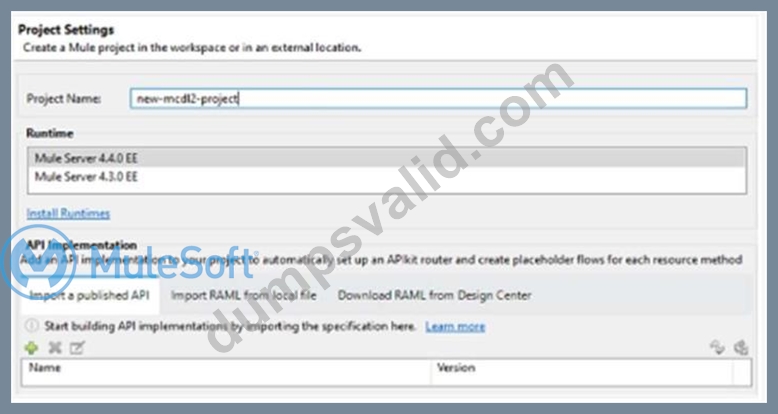
When creating a new project, which API implementation allows for selecting the correct API version and scaffolding the flows from the API specification?
- A. Download RAML from Design Center'
- B. Import RAML from local file
- C. Generate a local RAML from anypoint Studio
- D. Import a published API
Answer: D
Explanation:
Explanation
To create a new project that selects the correct API version and scaffolds the flows from the API specification, the developer should import a published API. This option allows importing an API specification that has been published to Anypoint Exchange or Design Center, and selecting a specific version of that API specification.
The developer can also choose to scaffold flows based on that API specification. References:
https://docs.mulesoft.com/apikit/4.x/apikit-4-new-project-task
NEW QUESTION # 50
A Mule API receives a JSON payload and updates the target system with the payload. The developer uses JSON schemas to ensure the data is valid.
How can the data be validation before posting to the target system?
- A. Use a DataWeave 2.09 transform operation, and at the log of the DataWeave script, add:
%dw 2.0
Import.json-moduls - B. Using the DataWeave if Else condition test the values of the payload against the examples included in the schema
- C. Add the JSON module dependency and add the validate-schema operation in the flow, configured to reference the schema
- D. Apply the JSON Schema policy in API Manager and reference the correct schema in the policy configuration
Answer: C
Explanation:
Explanation
To validate the data before posting to the target system, the developer should add the JSON module dependency and add the validate-schema operation in the flow, configured to reference the schema. The JSON module provides a validate-schema operation that validates a JSON payload against a JSON schema and throws an error if the payload is invalid. References:
https://docs.mulesoft.com/json-module/1.1/json-validate-schema
NEW QUESTION # 51
Which configurations are required for HTTP Listener to enable mTLS authentication?
- A. Set an appropriate reconnection strategy and use persistent connections for the listener
- B. Set an appropriate keystore and truststore configuration for the listener
- C. Set an appropriate keystore configuration and use persistent connections for the listener
- D. Set an appropriate truststore configuration and reconnection strategy for the listener
Answer: B
Explanation:
Explanation
To enable mTLS authentication for HTTP Listener, the developer needs to set an appropriate keystore and truststore configuration for the listener. The keystore contains the certificate and private key of the Mule application that are used to prove its identity to clients. The truststore contains the certificates of trusted clients that are allowed to access the Mule application. References:
https://docs.mulesoft.com/mule-runtime/4.3/tls-configuration#mutual-authentication
NEW QUESTION # 52
The HTTP Request operation raises an HTTP CONNECTIVITY error.
Which HTTP status code and body are returned to the web client?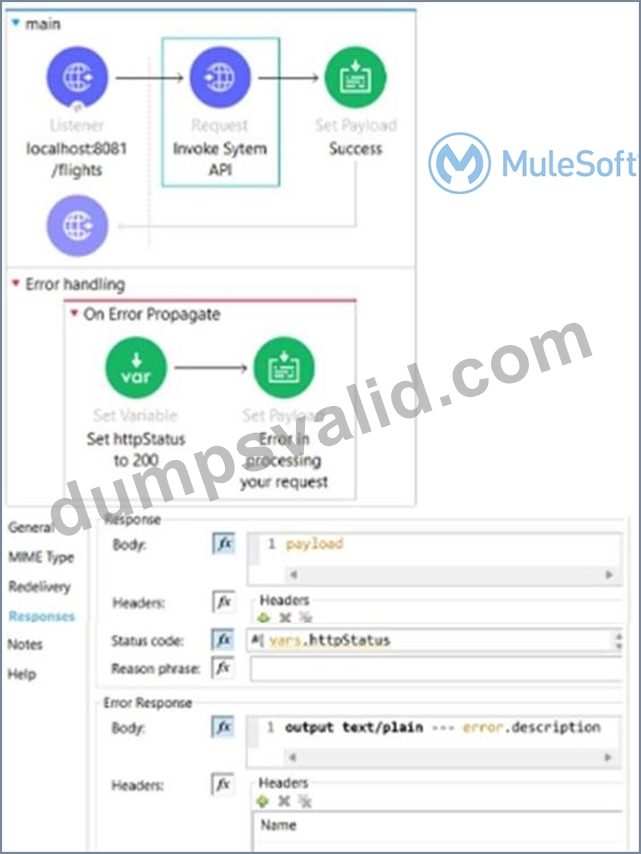
- A. HTTP Status Code:500.
Body 'Error in processing your request - B. HTTP Status Code:200.
Body 'Error in processing your request - C. HTTP Status Code:500.
Body 'The HTTP CONNECTIVITY Error description - D. HTTP Status Code:500.
Body 'Error in processing your request
Answer: D
Explanation:
Explanation
When the HTTP Request operation raises an HTTP CONNECTIVITY error, it triggers an on-error-continue handler that sets a payload with 'Error in processing your request'. Since no status code is explicitly set in this handler, it defaults to 500 (INTERNAL SERVER ERROR). Therefore, the web client receives an HTTP response with status code 500 and body 'Error in processing your request'. References:
https://docs.mulesoft.com/mule-runtime/4.3/error-handling#on-error-continue
NEW QUESTION # 53
Refer to the exhibit.
What required changes can be made to give a partial successful response in case the United Airlines API returns with a timeout?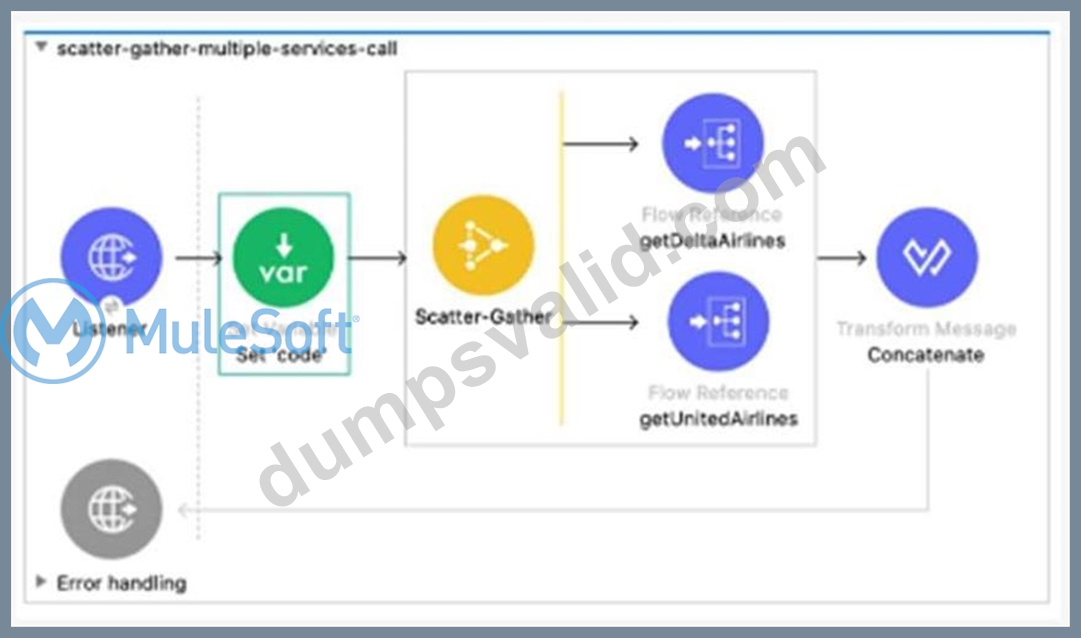
- A. Add a Scatter-Gather component inside a Try scope.
Set the payload to a default value 'Error'' inside the error handler using the On Error Continue scope. - B. Add Flow Reference components inside a Try scope
Set the payload to a default value '' inside the error handler using the On Error Propagate scope - C. Add Flow Reference components inside a Try scope.
Set the payload to a default value'' insider the error handler using the ON Error Continue scope - D. Add a Scatter-gather component inside a Try scope.
Set the payload to a default value 'Error' inside the error handler using the On Error Propagate scope.
Answer: A
Explanation:
Explanation
To give a partial successful response in case the United Airlines API returns with a timeout, the developer should add a Scatter-Gather component inside a Try scope, and set the payload to a default value 'Error' inside the error handler using the On Error Continue scope. A Scatter-Gather component allows sending multiple requests concurrently and aggregating the responses into an array. A Try scope allows handling errors that occur within it using an error handler. An On Error Continue scope allows continuing the flow execution after handling an error. Therefore, by using these components, the developer can send requests to both APIs in parallel, handle any timeout errors from United Airlines API, and return a partial response with a default value for that API. References: https://docs.mulesoft.com/mule-runtime/4.3/scatter-gather-concept
https://docs.mulesoft.com/mule-runtime/4.3/try-scope-concept
https://docs.mulesoft.com/mule-runtime/4.3/on-error-continue-concept
NEW QUESTION # 54
A developer is working on a project that requires encrypting all data before sending it to a backend application. To accomplish this, the developer will use PGP encryption in the Mule 4 Cryptography module.
What is required to encrypt the data before sending it to the backend application?
- A. The application needs the public key from the backend service to encrypt the data
- B. The application needs to both the private and public keys to encrypt the data
- C. The application needs the private key from the backend service to encrypt the data
- D. The application needs to configure HTTPS TLS context information to encrypt the data
Answer: A
Explanation:
Explanation
To encrypt the data before sending it to the backend application using PGP encryption, the application needs the public key from the backend service. PGP encryption uses a public-key cryptography system, which means that each party has a pair of keys: a public key and a private key. The public key is used to encrypt data, and the private key is used to decrypt data. Therefore, to encrypt data for a specific recipient (the backend service), the application needs to use the recipient's public key. The recipient can then use its own private key to decrypt the data. References: https://docs.mulesoft.com/mule-runtime/4.3/cryptography-pgp
NEW QUESTION # 55
......
Latest MCD-Level-2 Exam Dumps - Valid and Updated Dumps: https://www.dumpsvalid.com/MCD-Level-2-still-valid-exam.html