

[Apr-2024] Updated and Accurate CKS Questions & Answers for passing the exam Quickly
Download Real CKS Exam Dumps for candidates. 100% Free Dump Files
Linux Foundation CKS (Certified Kubernetes Security Specialist) Certification Exam is a professional certification program that is designed to validate the expertise of individuals in securing Kubernetes deployments. Kubernetes is a popular open-source platform used for container orchestration and management, and ensuring its security is of utmost importance. The CKS certification exam is a way for professionals to demonstrate their knowledge and experience in securing Kubernetes environments.
The CKS exam is a hands-on, performance-based exam that tests the candidate's ability to secure a Kubernetes cluster. CKS exam consists of 17 scenarios that simulate real-world situations that a Kubernetes administrator might face. The scenarios are designed to test the candidate's understanding of Kubernetes security concepts, their ability to identify and mitigate common vulnerabilities, and their knowledge of best practices for securing Kubernetes clusters. CKS exam is conducted online and can be taken from anywhere in the world. Candidates are required to pass the exam to earn the CKS certification, which is valid for two years.
NEW QUESTION # 21
SIMULATION
Create a network policy named allow-np, that allows pod in the namespace staging to connect to port 80 of other pods in the same namespace.
Ensure that Network Policy:-
1. Does not allow access to pod not listening on port 80.
2. Does not allow access from Pods, not in namespace staging.
Answer:
Explanation:
apiVersion: networking.k8s.io/v1
kind: NetworkPolicy
metadata:
name: network-policy
spec:
podSelector: {} #selects all the pods in the namespace deployed
policyTypes:
- Ingress
ingress:
- ports: #in input traffic allowed only through 80 port only
- protocol: TCP
port: 80
NEW QUESTION # 22
SIMULATION
Analyze and edit the given Dockerfile
FROM ubuntu:latest
RUN apt-get update -y
RUN apt-install nginx -y
COPY entrypoint.sh /
ENTRYPOINT ["/entrypoint.sh"]
USER ROOT
Fixing two instructions present in the file being prominent security best practice issues Analyze and edit the deployment manifest file apiVersion: v1 kind: Pod metadata:
name: security-context-demo-2
spec:
securityContext:
runAsUser: 1000
containers:
- name: sec-ctx-demo-2
image: gcr.io/google-samples/node-hello:1.0
securityContext:
runAsUser: 0
privileged: True
allowPrivilegeEscalation: false
Fixing two fields present in the file being prominent security best practice issues Don't add or remove configuration settings; only modify the existing configuration settings Whenever you need an unprivileged user for any of the tasks, use user test-user with the user id 5487
- A. Send us the Feedback on it.
Answer: A
NEW QUESTION # 23
Create a network policy named allow-np, that allows pod in the namespace staging to connect to port 80 of other pods in the same namespace.
Ensure that Network Policy:-
1. Does not allow access to pod not listening on port 80.
2. Does not allow access from Pods, not in namespace staging.
Answer:
Explanation:
apiVersion: networking.k8s.io/v1
kind: NetworkPolicy
metadata:
name: network-policy
spec:
podSelector: {} #selects all the pods in the namespace deployed
policyTypes:
- Ingress
ingress:
- ports: #in input traffic allowed only through 80 port only
- protocol: TCP
port: 80
NEW QUESTION # 24
Create a network policy named restrict-np to restrict to pod nginx-test running in namespace testing.
Only allow the following Pods to connect to Pod nginx-test:-
1. pods in the namespace default
2. pods with label version:v1 in any namespace.
Make sure to apply the network policy.
- A. Send us your Feedback on this.
Answer: A
NEW QUESTION # 25
Create a RuntimeClass named untrusted using the prepared runtime handler named runsc.
Create a Pods of image alpine:3.13.2 in the Namespace default to run on the gVisor runtime class.
Answer:
Explanation: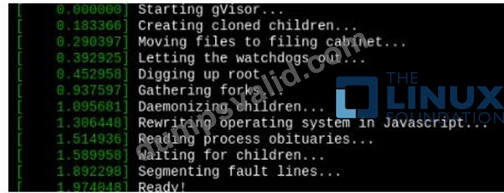
NEW QUESTION # 26
SIMULATION
Given an existing Pod named nginx-pod running in the namespace test-system, fetch the service-account-name used and put the content in /candidate/KSC00124.txt Create a new Role named dev-test-role in the namespace test-system, which can perform update operations, on resources of type namespaces.
Create a new RoleBinding named dev-test-role-binding, which binds the newly created Role to the Pod's ServiceAccount ( found in the Nginx pod running in namespace test-system).
- A. Sendusyourfeedbackonit
Answer: A
NEW QUESTION # 27
Cluster: qa-cluster
Master node: master Worker node: worker1
You can switch the cluster/configuration context using the following command:
[desk@cli] $ kubectl config use-context qa-cluster
Task:
Create a NetworkPolicy named restricted-policy to restrict access to Pod product running in namespace dev.
Only allow the following Pods to connect to Pod products-service:
1. Pods in the namespace qa
2. Pods with label environment: stage, in any namespace
Answer:
Explanation:
$ k get ns qa --show-labels
NAME STATUS AGE LABELS
qa Active 47m env=stage
$ k get pods -n dev --show-labels
NAME READY STATUS RESTARTS AGE LABELS
product 1/1 Running 0 3s env=dev-team
apiVersion: networking.k8s.io/v1
kind: NetworkPolicy
metadata:
name: restricted-policy
namespace: dev
spec:
podSelector:
matchLabels:
env: dev-team
policyTypes:
- Ingress
ingress:
- from:
- namespaceSelector:
matchLabels:
env: stage
- podSelector:
matchLabels:
env: stage
[desk@cli] $ k get ns qa --show-labels
NAME STATUS AGE LABELS
qa Active 47m env=stage
[desk@cli] $ k get pods -n dev --show-labels
NAME READY STATUS RESTARTS AGE LABELS
product 1/1 Running 0 3s env=dev-team
[desk@cli] $ vim netpol2.yaml
apiVersion: networking.k8s.io/v1
kind: NetworkPolicy
metadata:
name: restricted-policy
namespace: dev
spec:
podSelector:
matchLabels:
env: dev-team
policyTypes:
- Ingress
ingress:
- from:
- namespaceSelector:
matchLabels:
env: stage
- podSelector:
matchLabels:
env: stage
[desk@cli] $ k apply -f netpol2.yaml Reference: https://kubernetes.io/docs/concepts/services-networking/network-policies/
[desk@cli] $ k apply -f netpol2.yaml Reference: https://kubernetes.io/docs/concepts/services-networking/network-policies/
NEW QUESTION # 28
Enable audit logs in the cluster, To Do so, enable the log backend, and ensure that
1. logs are stored at /var/log/kubernetes/kubernetes-logs.txt.
2. Log files are retained for 5 days.
3. at maximum, a number of 10 old audit logs files are retained.
Edit and extend the basic policy to log:
- A. 1. Cronjobs changes at RequestResponse
Answer: A
Explanation:
2. Log the request body of deployments changes in the namespace kube-system.
3. Log all other resources in core and extensions at the Request level.
4. Don't log watch requests by the "system:kube-proxy" on endpoints or
NEW QUESTION # 29
You can switch the cluster/configuration context using the following command: [desk@cli] $ kubectl config use-context qa Context: A pod fails to run because of an incorrectly specified ServiceAccount Task: Create a new service account named backend-qa in an existing namespace qa, which must not have access to any secret. Edit the frontend pod yaml to use backend-qa service account Note: You can find the frontend pod yaml at /home/cert_masters/frontend-pod.yaml
Answer:
Explanation:
[desk@cli] $ k create sa backend-qa -n qa sa/backend-qa created [desk@cli] $ k get role,rolebinding -n qa No resources found in qa namespace. [desk@cli] $ k create role backend -n qa --resource pods,namespaces,configmaps --verb list # No access to secret [desk@cli] $ k create rolebinding backend -n qa --role backend --serviceaccount qa:backend-qa [desk@cli] $ vim /home/cert_masters/frontend-pod.yaml apiVersion: v1 kind: Pod metadata:
name: frontend
spec:
serviceAccountName: backend-qa # Add this
image: nginx
name: frontend
[desk@cli] $ k apply -f /home/cert_masters/frontend-pod.yaml pod created
[desk@cli] $ k create sa backend-qa -n qa serviceaccount/backend-qa created [desk@cli] $ k get role,rolebinding -n qa No resources found in qa namespace. [desk@cli] $ k create role backend -n qa --resource pods,namespaces,configmaps --verb list role.rbac.authorization.k8s.io/backend created [desk@cli] $ k create rolebinding backend -n qa --role backend --serviceaccount qa:backend-qa rolebinding.rbac.authorization.k8s.io/backend created [desk@cli] $ vim /home/cert_masters/frontend-pod.yaml apiVersion: v1 kind: Pod metadata:
name: frontend
spec:
serviceAccountName: backend-qa # Add this
image: nginx
name: frontend
[desk@cli] $ k apply -f /home/cert_masters/frontend-pod.yaml pod/frontend created https://kubernetes.io/docs/tasks/configure-pod-container/configure-service-account/
NEW QUESTION # 30
SIMULATION
Create a User named john, create the CSR Request, fetch the certificate of the user after approving it.
Create a Role name john-role to list secrets, pods in namespace john
Finally, Create a RoleBinding named john-role-binding to attach the newly created role john-role to the user john in the namespace john. To Verify: Use the kubectl auth CLI command to verify the permissions.
Answer:
Explanation:
se kubectl to create a CSR and approve it.
Get the list of CSRs:
kubectl get csr
Approve the CSR:
kubectl certificate approve myuser
Get the certificate
Retrieve the certificate from the CSR:
kubectl get csr/myuser -o yaml
here are the role and role-binding to give john permission to create NEW_CRD resource:
kubectl apply -f roleBindingJohn.yaml --as=john
rolebinding.rbac.authorization.k8s.io/john_external-rosource-rb created kind: RoleBinding apiVersion: rbac.authorization.k8s.io/v1 metadata:
name: john_crd
namespace: development-john
subjects:
- kind: User
name: john
apiGroup: rbac.authorization.k8s.io
roleRef:
kind: ClusterRole
name: crd-creation
kind: ClusterRole
apiVersion: rbac.authorization.k8s.io/v1
metadata:
name: crd-creation
rules:
- apiGroups: ["kubernetes-client.io/v1"]
resources: ["NEW_CRD"]
verbs: ["create, list, get"]
NEW QUESTION # 31
Create a Pod name Nginx-pod inside the namespace testing, Create a service for the Nginx-pod named nginx-svc, using the ingress of your choice, run the ingress on tls, secure port.
- A. Send us your Feedback on this.
Answer: A
NEW QUESTION # 32
SIMULATION
Secrets stored in the etcd is not secure at rest, you can use the etcdctl command utility to find the secret value for e.g:- ETCDCTL_API=3 etcdctl get /registry/secrets/default/cks-secret --cacert="ca.crt" --cert="server.crt" --key="server.key" Output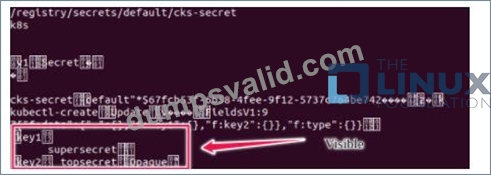
Using the Encryption Configuration, Create the manifest, which secures the resource secrets using the provider AES-CBC and identity, to encrypt the secret-data at rest and ensure all secrets are encrypted with the new configuration.
- A. Send us the Feedback on it.
Answer: A
NEW QUESTION # 33
a. Retrieve the content of the existing secret named default-token-xxxxx in the testing namespace.
Store the value of the token in the token.txt
b. Create a new secret named test-db-secret in the DB namespace with the following content:
username: mysql
password: password@123
Create the Pod name test-db-pod of image nginx in the namespace db that can access test-db-secret via a volume at path /etc/mysql-credentials
Answer:
Explanation:
To add a Kubernetes cluster to your project, group, or instance:
Navigate to your:
Project's Operations > Kubernetes page, for a project-level cluster.
Group's Kubernetes page, for a group-level cluster.
Admin Area > Kubernetes page, for an instance-level cluster.
Click Add Kubernetes cluster.
Click the Add existing cluster tab and fill in the details:
Kubernetes cluster name (required) - The name you wish to give the cluster.
Environment scope (required) - The associated environment to this cluster.
API URL (required) - It's the URL that GitLab uses to access the Kubernetes API. Kubernetes exposes several APIs, we want the "base" URL that is common to all of them. For example, https://kubernetes.example.com rather than https://kubernetes.example.com/api/v1.
Get the API URL by running this command:
kubectl cluster-info | grep -E 'Kubernetes master|Kubernetes control plane' | awk '/http/ {print $NF}' CA certificate (required) - A valid Kubernetes certificate is needed to authenticate to the cluster. We use the certificate created by default.
List the secrets with kubectl get secrets, and one should be named similar to default-token-xxxxx. Copy that token name for use below.
Get the certificate by running this command:
kubectl get secret <secret name> -o jsonpath="{['data']['ca\.crt']}"
NEW QUESTION # 34
SIMULATION
Enable audit logs in the cluster, To Do so, enable the log backend, and ensure that
1. logs are stored at /var/log/kubernetes-logs.txt.
2. Log files are retained for 12 days.
3. at maximum, a number of 8 old audit logs files are retained.
4. set the maximum size before getting rotated to 200MB
Edit and extend the basic policy to log:
1. namespaces changes at RequestResponse
2. Log the request body of secrets changes in the namespace kube-system.
3. Log all other resources in core and extensions at the Request level.
4. Log "pods/portforward", "services/proxy" at Metadata level.
5. Omit the Stage RequestReceived
All other requests at the Metadata level
Answer:
Explanation:
Kubernetes auditing provides a security-relevant chronological set of records about a cluster. Kube-apiserver performs auditing. Each request on each stage of its execution generates an event, which is then pre-processed according to a certain policy and written to a backend. The policy determines what's recorded and the backends persist the records.
You might want to configure the audit log as part of compliance with the CIS (Center for Internet Security) Kubernetes Benchmark controls.
The audit log can be enabled by default using the following configuration in cluster.yml:
services:
kube-api:
audit_log:
enabled: true
When the audit log is enabled, you should be able to see the default values at /etc/kubernetes/audit-policy.yaml The log backend writes audit events to a file in JSONlines format. You can configure the log audit backend using the following kube-apiserver flags:
--audit-log-path specifies the log file path that log backend uses to write audit events. Not specifying this flag disables log backend. - means standard out
--audit-log-maxage defined the maximum number of days to retain old audit log files
--audit-log-maxbackup defines the maximum number of audit log files to retain
--audit-log-maxsize defines the maximum size in megabytes of the audit log file before it gets rotated If your cluster's control plane runs the kube-apiserver as a Pod, remember to mount the hostPath to the location of the policy file and log file, so that audit records are persisted. For example:
--audit-policy-file=/etc/kubernetes/audit-policy.yaml \
--audit-log-path=/var/log/audit.log
NEW QUESTION # 35
SIMULATION
Given an existing Pod named test-web-pod running in the namespace test-system Edit the existing Role bound to the Pod's Service Account named sa-backend to only allow performing get operations on endpoints.
Create a new Role named test-system-role-2 in the namespace test-system, which can perform patch operations, on resources of type statefulsets.
Create a new RoleBinding named test-system-role-2-binding binding the newly created Role to the Pod's ServiceAccount sa-backend.
- A. Send us your feedback on this.
Answer: A
NEW QUESTION # 36
Context:
Cluster: prod
Master node: master1
Worker node: worker1
You can switch the cluster/configuration context using the following command:
[desk@cli] $ kubectl config use-context prod
Task:
Analyse and edit the given Dockerfile (based on the ubuntu:18:04 image)
/home/cert_masters/Dockerfile fixing two instructions present in the file being prominent security/best-practice issues.
Analyse and edit the given manifest file
/home/cert_masters/mydeployment.yaml fixing two fields present in the file being prominent security/best-practice issues.
Note: Don't add or remove configuration settings; only modify the existing configuration settings, so that two configuration settings each are no longer security/best-practice concerns.
Should you need an unprivileged user for any of the tasks, use user nobody with user id 65535
Answer:
Explanation:
1. For Dockerfile: Fix the image version & user name in Dockerfile
2. For mydeployment.yaml : Fix security contexts
Explanation
[desk@cli] $ vim /home/cert_masters/Dockerfile
FROM ubuntu:latest # Remove this
FROM ubuntu:18.04 # Add this
USER root # Remove this
USER nobody # Add this
RUN apt get install -y lsof=4.72 wget=1.17.1 nginx=4.2
ENV ENVIRONMENT=testing
USER root # Remove this
USER nobody # Add this
CMD ["nginx -d"]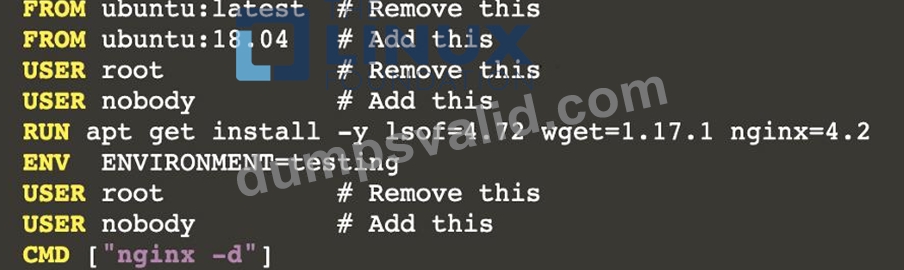
[desk@cli] $ vim /home/cert_masters/mydeployment.yaml
apiVersion: apps/v1
kind: Deployment
metadata:
creationTimestamp: null
labels:
app: kafka
name: kafka
spec:
replicas: 1
selector:
matchLabels:
app: kafka
strategy: {}
template:
metadata:
creationTimestamp: null
labels:
app: kafka
spec:
containers:
- image: bitnami/kafka
name: kafka
volumeMounts:
- name: kafka-vol
mountPath: /var/lib/kafka
securityContext:
{"capabilities":{"add":["NET_ADMIN"],"drop":["all"]},"privileged": True,"readOnlyRootFilesystem": False, "runAsUser": 65535} # Delete This
{"capabilities":{"add":["NET_ADMIN"],"drop":["all"]},"privileged": False,"readOnlyRootFilesystem": True, "runAsUser": 65535} # Add This resources: {} volumes:
- name: kafka-vol
emptyDir: {}
status: {}
Pictorial View:
[desk@cli] $ vim /home/cert_masters/mydeployment.yaml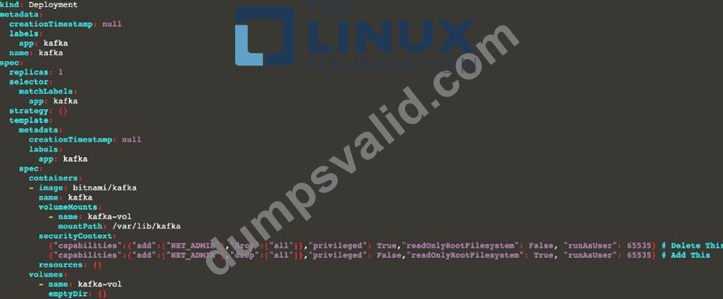
NEW QUESTION # 37
use the Trivy to scan the following images,
1. amazonlinux:1
2. k8s.gcr.io/kube-controller-manager:v1.18.6
Look for images with HIGH or CRITICAL severity vulnerabilities and store the output of the same in /opt/trivy-vulnerable.txt
- A. Send us your suggestion on it.
- B. Send us your suggestion
Answer: A
NEW QUESTION # 38
A container image scanner is set up on the cluster.
Given an incomplete configuration in the directory
/etc/Kubernetes/confcontrol and a functional container image scanner with HTTPS endpoint https://acme.local.8081/image_policy
- A. 1. Enable the admission plugin.
Answer: A
Explanation:
2. Validate the control configuration and change it to implicit deny.
Finally, test the configuration by deploying the pod having the image tag as the latest.
NEW QUESTION # 39
Secrets stored in the etcd is not secure at rest, you can use the etcdctl command utility to find the secret value for e.g:-
- A. ETCDCTL_API=3 etcdctl get /registry/secrets/default/cks-secret --cacert="ca.crt" --cert="server.crt" --key="server.key"
Answer: A
Explanation:
Output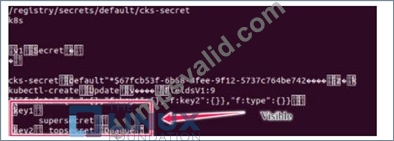
Using the Encryption Configuration, Create the manifest, which secures the resource secrets using the provider AES-CBC and identity, to encrypt the secret-data at rest and ensure all secrets are encrypted with the new configuration.
NEW QUESTION # 40
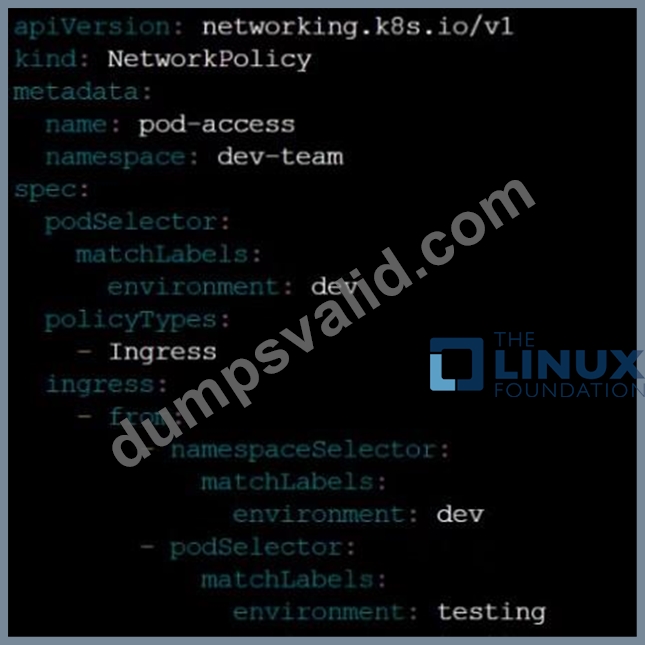
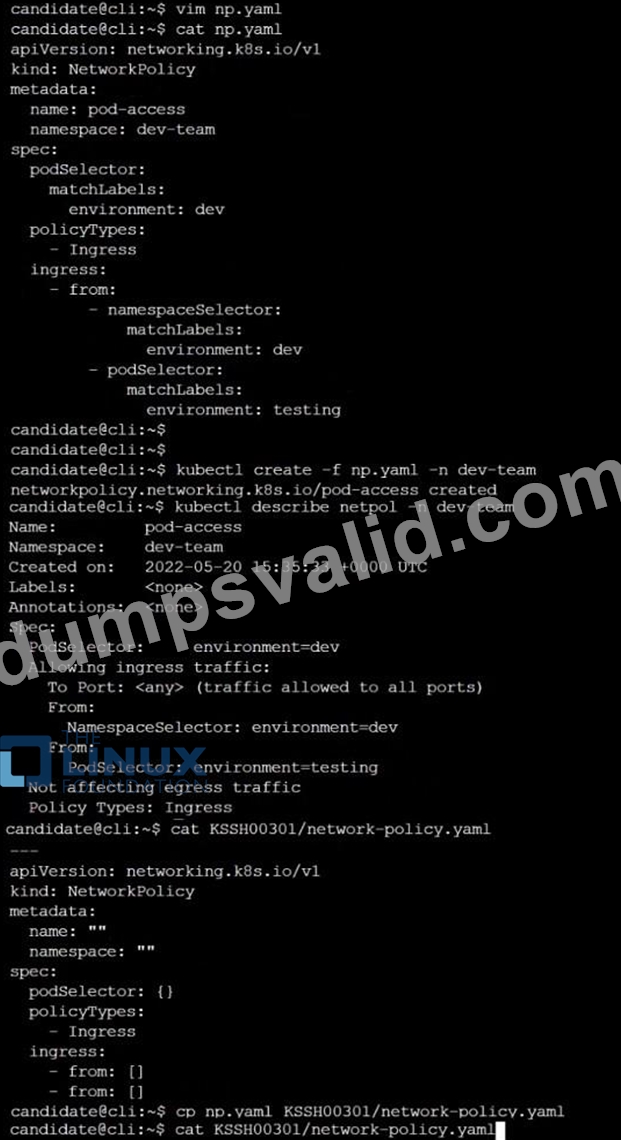
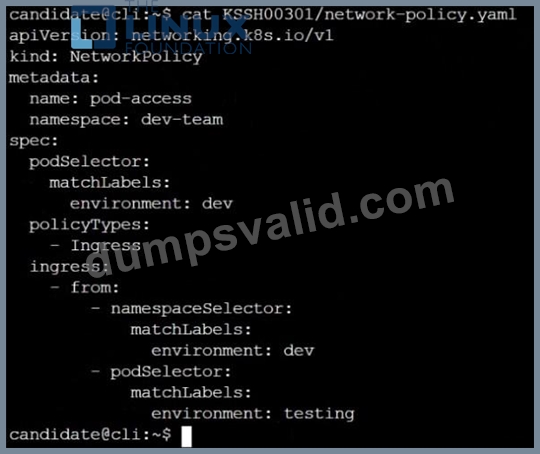
Cluster: qa-cluster Master node: master Worker node: worker1 You can switch the cluster/configuration context using the following command: [desk@cli] $ kubectl config use-context qa-cluster Task: Create a NetworkPolicy named restricted-policy to restrict access to Pod product running in namespace dev. Only allow the following Pods to connect to Pod products-service: 1. Pods in the namespace qa 2. Pods with label environment: stage, in any namespace
Answer:
Explanation: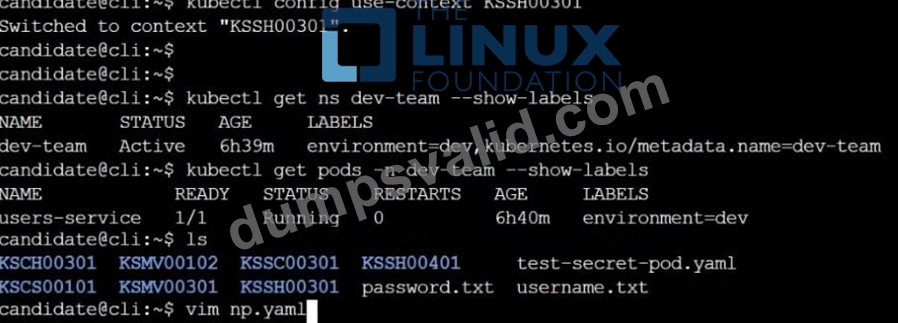
NEW QUESTION # 41
Using the runtime detection tool Falco, Analyse the container behavior for at least 20 seconds, using filters that detect newly spawning and executing processes in a single container of Nginx.
store the incident file art /opt/falco-incident.txt, containing the detected incidents. one per line, in the format
[timestamp],[uid],[processName]
- A. Send us your feedback on it.
- B. Send us your
Answer: A
NEW QUESTION # 42
You must complete this task on the following cluster/nodes: Cluster: immutable-cluster Master node: master1 Worker node: worker1 You can switch the cluster/configuration context using the following command:
[desk@cli] $ kubectl config use-context immutable-cluster
Context: It is best practice to design containers to be stateless and immutable.
Task:
Inspect Pods running in namespace prod and delete any Pod that is either not stateless or not immutable.
Use the following strict interpretation of stateless and immutable:
1. Pods being able to store data inside containers must be treated as not stateless.
Note: You don't have to worry whether data is actually stored inside containers or not already.
2. Pods being configured to be privileged in any way must be treated as potentially not stateless or not immutable.
Answer:
Explanation:
k get pods -n prod
k get pod <pod-name> -n prod -o yaml | grep -E 'privileged|ReadOnlyRootFileSystem' Delete the pods which do have any of these 2 properties privileged:true or ReadOnlyRootFileSystem: false
[desk@cli]$ k get pods -n prod
NAME READY STATUS RESTARTS AGE
cms 1/1 Running 0 68m
db 1/1 Running 0 4m
nginx 1/1 Running 0 23m
[desk@cli]$ k get pod nginx -n prod -o yaml | grep -E 'privileged|RootFileSystem'
{"apiVersion":"v1","kind":"Pod","metadata":{"annotations":{},"creationTimestamp":null,"labels":{"run":"nginx"},"name":"nginx","namespace":"prod"},"spec":{"containers":[{"image":"nginx","name":"nginx","resources":{},"securityContext":{"privileged":true}}],"dnsPolicy":"ClusterFirst","restartPolicy":"Always"},"status":{}} f:privileged: {} privileged: true
[desk@cli]$ k delete pod nginx -n prod
[desk@cli]$ k get pod db -n prod -o yaml | grep -E 'privileged|RootFilesystem'
[desk@cli]$ k delete pod cms -n prod Reference: https://kubernetes.io/docs/concepts/policy/pod-security-policy/ https://cloud.google.com/architecture/best-practices-for-operating-containers Reference:
[desk@cli]$ k delete pod cms -n prod Reference: https://kubernetes.io/docs/concepts/policy/pod-security-policy/ https://cloud.google.com/architecture/best-practices-for-operating-containers
NEW QUESTION # 43
Create a RuntimeClass named untrusted using the prepared runtime handler named runsc.
Create a Pods of image alpine:3.13.2 in the Namespace default to run on the gVisor runtime class.
Answer:
Explanation:
Verify: Exec the pods and run the dmesg, you will see output like this:-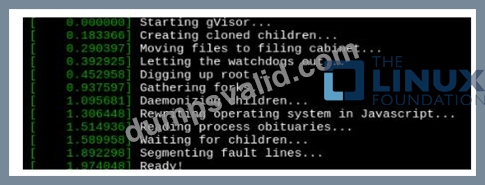
NEW QUESTION # 44
......
Linux Foundation CKS (Certified Kubernetes Security Specialist) exam is a certification program aimed at validating the skills of individuals in securing Kubernetes clusters. Kubernetes is a popular container orchestration platform used in cloud-native applications, and its security is paramount. CKS exam is designed to test the candidate's knowledge of various security concepts, tools, and practices that are essential in securing Kubernetes clusters.
Prepare Important Exam with CKS Exam Dumps: https://www.dumpsvalid.com/CKS-still-valid-exam.html
Pass Exam Questions Efficiently With CKS Questions: https://drive.google.com/open?id=1v2C5KLgfyrbBq0JwGZDIBW6Zm1SmQrDJ