

[UPDATED 2026] Getting Cybersecurity-Practitioner Certification Made Easy!
Cybersecurity-Practitioner Exam Crack Test Engine Dumps Training With 227 Questions
Palo Alto Networks Cybersecurity-Practitioner Exam Syllabus Topics:
| Topic | Details |
|---|---|
| Topic 1 |
|
| Topic 2 |
|
| Topic 3 |
|
NEW QUESTION # 45
Systems that allow for accelerated incident response through the execution of standardized and automated playbooks that work upon inputs from security technology and other data flows are known as what?
- A. SIEM
- B. XDR
- C. SOAR
- D. STEP
Answer: C
Explanation:
SOAR stands for security orchestration, automation and response. It is a software solution that enables security teams to integrate and coordinate separate tools into streamlined threat response workflows. SOAR systems allow for accelerated incident response through the execution of standardized and automated playbooks that work upon inputs from security technology and other data flows. SOAR systems can also help ensure consistency, reduce human errors, and improve efficiency and scalability of security operations. Reference:
Security Operations Infrastructure from Palo Alto Networks
What is SOAR (security orchestration, automation and response)? from IBM Security Operations Fundamentals (SOF) Flashcards from Quizlet
NEW QUESTION # 46
The seventy of an attack needs to be escalated.
What needs to be in place in order for the security operations team to properly inform various units within the enterprise of the issue?
- A. Interface Agreement
- B. FAO Incident Site -
- C. Corporate Executive Listserv
- D. Security Breach Blog
Answer: A
NEW QUESTION # 47
Which attacker profile acts independently or as part of an unlawful organization?
- A. hacktivist
- B. state-affiliated group
- C. cybercriminal
- D. cyberterrorist
Answer: C
Explanation:
Cybercriminals are attackers who act independently or as part of an unlawful organization, such as a crime syndicate or a hacker group. Their main motivation is to make money by exploiting vulnerabilities in systems, networks, or applications. They use various methods, such as ransomware, phishing, identity theft, fraud, or botnets, to steal data, extort victims, or disrupt services. Cybercriminals often target individuals, businesses, or institutions that have valuable or sensitive information, such as financial, personal, or health data. Cybercriminals are constantly evolving their techniques and tools to evade detection and countermeasures. They may also collaborate with other cybercriminals or hire hackers to perform specific tasks. Reference:
Cybersecurity Threats: Cybercriminals
Attackers Profile
NEW QUESTION # 48
Why is it important to protect East-West traffic within a private cloud?
- A. All traffic contains threats, so enterprises must protect against threats across the entire network
- B. East-West traffic contains more threats than other traffic
- C. East-West traffic contains more session-oriented traffic than other traffic
- D. East-West traffic uses IPv6 which is less secure than IPv4
Answer: A
Explanation:
East-West traffic is the lateral movement of data packets between servers within a data center, or across private and public clouds1. This type of traffic has grown substantially with the proliferation of data centers and cloud adoption, and it now surpasses the conventional North-South traffic that goes in or out of the network2. Therefore, it is important to protect East-West traffic from potential malicious actors and breaches, as threats can arise internally and move laterally without ever touching the traditional network perimeter12. By inspecting and monitoring all East-West traffic, organizations can effectively block the lateral movement of threat actors, increase network visibility, protect vital applications and data, and lower costs and risks for distributed operations23. Reference:
East-West Traffic: Everything You Need to Know | Gigamon Blog
What is East-West Security? | VMware Glossary
How to Harness East-West Visibility for a Stronger Defensive Security ...
NEW QUESTION # 49
What is required for an effective Attack Surface Management (ASM) process?
- A. Real-time data rich inventory
- B. Periodic manual monitoring
- C. Isolation of assets by default
- D. Static inventory of assets
Answer: A
Explanation:
An effective Attack Surface Management (ASM) process requires a real-time, data-rich inventory of all internet-facing assets. This enables continuous visibility, timely detection of vulnerabilities, and identification of exposures that attackers could exploit.
NEW QUESTION # 50
Which type of Software as a Service (SaaS) application provides business benefits, is fast to deploy, requires minimal cost and is infinitely scalable?
- A. Tolerated
- B. Secure
- C. Benign
- D. Sanctioned
Answer: D
Explanation:
Sanctioned SaaS applications are those that are approved and supported by the organization's IT department. They provide business benefits such as increased productivity, collaboration, and efficiency. They are fast to deploy because they do not require installation or maintenance on the user's device. They require minimal cost because they are usually paid on a subscription or usage basis, and they do not incur hardware or software expenses. They are infinitely scalable because they can adjust to the changing needs and demands of the organization without affecting performance or availability12. Reference: 8 Types of SaaS Solutions You Must Know About in 2024, What is SaaS (Software as a Service)? | SaaS Types | CDW, Palo Alto Networks Certified Cybersecurity Entry-level Technician
NEW QUESTION # 51
Which technology grants enhanced visibility and threat prevention locally on a device?
- A. SIEM
- B. IDS
- C. DLP
- D. EDR
Answer: D
Explanation:
Endpoint Detection and Response (EDR) technologies provide comprehensive visibility and real-time threat prevention directly on endpoint devices. EDR continuously monitors process activities, file executions, and system calls to detect malware, suspicious behaviors, and zero-day threats at the source. Palo Alto Networks' Cortex XDR platform exemplifies this by correlating endpoint telemetry with network and cloud data to provide a holistic defense against attacks. Operating locally on endpoints allows EDR to prevent lateral movement and respond to threats quickly, filling security gaps that network-centric tools alone cannot address. This endpoint-level insight is critical to identifying sophisticated threats that initiate or manifest on user devices.
NEW QUESTION # 52
When signature-based antivirus software detects malware, what three things does it do to provide protection? (Choose three.)
- A. decrypt the infected file using base64
- B. alert system administrators
- C. remove the infected file's extension
- D. delete the infected file
- E. quarantine the infected file
Answer: B,D,E
Explanation:
Signature-based antivirus software is a type of security software that uses signatures to identify malware. Signatures are bits of code that are unique to a specific piece of malware. When signature-based antivirus software detects a piece of malware, it compares the signature to its database of known signatures12. If a match is found, the software can do three things to provide protection:
Alert system administrators: The software can notify the system administrators or the users about the malware detection, and provide information such as the name, type, location, and severity of the malware. This can help the administrators or the users to take appropriate actions to prevent further damage or infection3.
Quarantine the infected file: The software can isolate the infected file from the rest of the system, and prevent it from accessing or modifying any other files or processes. This can help to contain the malware and limit its impact on the system4.
Delete the infected file: The software can remove the infected file from the system, and prevent it from running or spreading. This can help to eliminate the malware and restore the system to a clean state4.
:
What is a signature-based antivirus? - Info Exchange
What is a Signature and How Can I detect it? - Sophos
How Does Heuristic Analysis Antivirus Software Work?
What Is Signature-based Malware Detection? | RiskXchange
NEW QUESTION # 53
Which pillar of Prisma Cloud application security does vulnerability management fall under?
- A. identity security
- B. dynamic computing
- C. network protection
- D. compute security
Answer: D
Explanation:
Prisma Cloud comprises four pillars:
* Visibility, governance, and compliance. Gain deep visibility into the security posture of multicloud environments. Track everything that gets deployed with an automated asset inventory, and maintain compliance with out-of-the-box governance policies that enforce good behavior across your environments.
* Compute security. Secure hosts, containers, and serverless workloads throughout the application lifecycle. Detect and prevent risks by integrating vulnerability intelligence into your integrated development environment (IDE), software configuration management (SCM), and CI/CD workflows. Enforce machine learning-based runtime protection to protect applications and workloads in real time.
* Network protection. Continuously monitor network activity for anomalous behavior, enforce microservice-aware micro-segmentation, and implement industry-leading firewall protection. Protect the network perimeter and the connectivity between containers and hosts.
* Identity security. Monitor and leverage user and entity behavior analytics (UEBA) across your environments to detect and block malicious actions. Gain visibility into and enforce governance p
NEW QUESTION # 54
Which two processes are critical to a security information and event management (SIEM) platform? (Choose two.)
- A. Ingestion of log data
- B. Automation of security deployments
- C. Detection of threats using data analysis
- D. Prevention of cvbersecurity attacks
Answer: A,C
Explanation:
Detection of threats using data analysis - SIEM platforms analyze collected data to identify suspicious patterns and detect threats.
Ingestion of log data - SIEM systems collect and centralize log data from various sources, which is essential for analysis, correlation, and alerting.
Automation and prevention are more aligned with SOAR and firewall/EDR functionalities, not the core operations of SIEM.
NEW QUESTION # 55
What differentiates SOAR from SIEM?
- A. SOAR platforms collect data and send alerts.
- B. SOAR platforms focus on analyzing network traffic.
- C. SOAR platforms filter alerts with their broader coverage of security incidents.
- D. SOAR platforms integrate automated response into the investigation process.
Answer: D
Explanation:
SOAR (Security Orchestration, Automation, and Response) differs from SIEM by adding automated incident response and workflow orchestration to the detection and alerting capabilities found in SIEM. This enables faster and more efficient handling of security incidents.
NEW QUESTION # 56
In the attached network diagram, which device is the switch?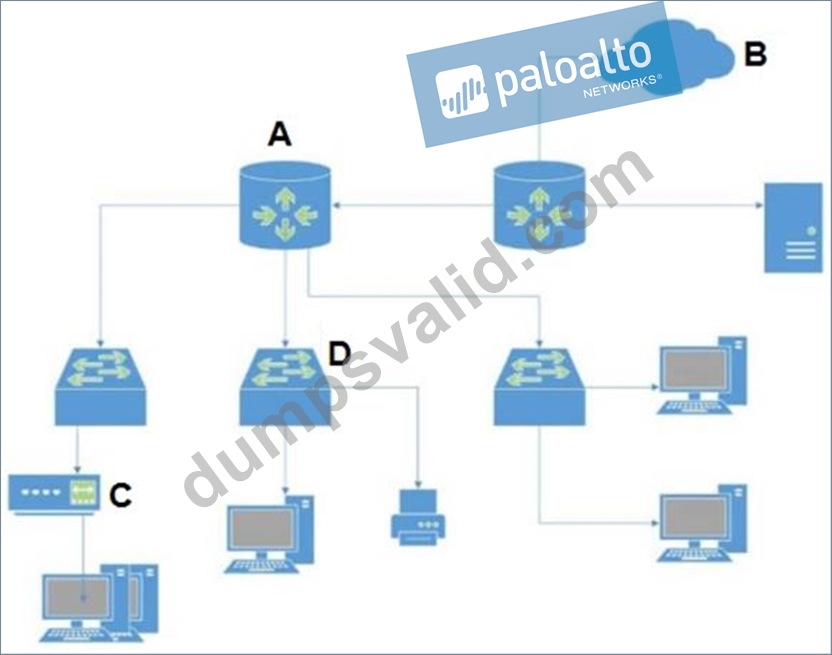
- A. C
- B. B
- C. D
- D. A
Answer: C
Explanation:
A switch is a network device that connects multiple devices on a local area network (LAN) and forwards data packets between them. A switch can be identified by its icon, which is a rectangle with four curved lines on each side. In the attached network diagram, device D is the switch, as it matches the icon and connects three computers to device A, which is another network device. Reference:
[What is a Network Switch and How Does it Work?]
[Network Diagram Symbols and Icons | Lucidchart]
NEW QUESTION # 57
What are two examples of an attacker using social engineering? (Choose two.)
- A. Acting as a company representative and asking for personal information not relevant to the reason for their call
- B. Leveraging open-source intelligence to gather information about a high-level executive
- C. Compromising a website and configuring it to automatically install malicious files onto systems that visit the page
- D. Convincing an employee that they are also an employee
Answer: A,D
Explanation:
Social engineering attacks manipulate human trust to gain unauthorized access or information. Convincing an employee that an attacker is also an employee builds rapport, lowering defenses for information disclosure or credential sharing. Similarly, impersonating a company representative and requesting unrelated personal data exploits authority bias to deceive victims. These tactics exploit psychological vulnerabilities rather than technical flaws and are prevalent initial steps in multi-stage attacks. Palo Alto Networks highlights the importance of training, multi-factor authentication, and behavior-based threat detection to mitigate social engineering risks effectively.
NEW QUESTION # 58
Which classification of IDS/IPS uses a database of known vulnerabilities and attack profiles to identify intrusion attempts?
- A. Behavior-based
- B. Anomaly-based
- C. Statistical-based
- D. Knowledge-based
Answer: D
Explanation:
A knowledge-based system uses a database of known vulnerabilities and attack profiles to identify intrusion attempts. These types of systems have lower false-alarm rates than behavior-based systems but must be continually updated with new attack signatures to be effective.
* A behavior-based system uses a baseline of normal network activity to identify unusual patterns or levels of network activity that may be indicative of an intrusion attempt.
These types of systems are more adaptive than knowledge-based systems and therefore may be more effective in detecting previously unknown vulnerabilities and attacks, but they have a much higher false-positive rate than knowledge-based systems.
NEW QUESTION # 59
Which tool supercharges security operations center (SOC) efficiency with the world's most comprehensive operating platform for enterprise security?
- A. Cortex XDR
- B. Prisma SAAS
- C. Cortex XSOAR
- D. WildFire
Answer: C
Explanation:
Cortex XSOAR enhances Security Operations Center (SOC) efficiency with the world's most comprehensive operating platform for enterprise security. Cortex XSOAR unifies case management, automation, real-time collaboration, and native threat intel management in the industry's first extended security orchestration, automation, and response (SOAR) offering.
NEW QUESTION # 60
Which security component should you configure to block viruses not seen and blocked by the perimeter firewall?
- A. endpoint disk encryption
- B. strong endpoint passwords
- C. endpoint antivirus software
- D. endpoint NIC ACLs
Answer: C
Explanation:
Endpoint antivirus software is a type of software designed to help detect, prevent, and eliminate malware on devices, such as laptops, desktops, smartphones, and tablets. Endpoint antivirus software can block viruses that are not seen and blocked by the perimeter firewall, which is a network security device that monitors and controls incoming and outgoing network traffic based on predefined security rules. Perimeter firewall can block some known viruses, but it may not be able to detect and stop new or unknown viruses that use advanced techniques to evade detection. Endpoint antivirus software can provide an additional layer of protection by scanning the files and processes on the devices and using various methods, such as signatures, heuristics, behavior analysis, and cloud-based analysis, to identify and remove malicious code123. Reference:
What Is Endpoint Antivirus? Key Features & Solutions Explained - Trellix Microsoft Defender for Endpoint | Microsoft Security Download ESET Endpoint Antivirus | ESET
NEW QUESTION # 61
Which type of malware takes advantage of a vulnerability on an endpoint or server?
- A. patch
- B. technique
- C. exploit
- D. vulnerability
Answer: C
Explanation:
An exploit is a type of malware that takes advantage of a vulnerability on an endpoint or server to execute malicious code, gain unauthorized access, or perform other malicious actions. Exploits can be categorized into known and unknown (i.e., zero-day) exploits, depending on whether the vulnerability is publicly disclosed or not12. Exploits can target various types of software, such as operating systems, browsers, applications, or network devices3. Reference: Malware vs. Exploits, Top Routinely Exploited Vulnerabilities, 12 Types of Malware + Examples That You Should Know, Palo Alto Networks Certified Cybersecurity Entry-level Technician
NEW QUESTION # 62
Which three services are part of Prisma SaaS? (Choose three.)
- A. Denial of Service
- B. Threat Prevention
- C. Data Loss Prevention
- D. Data Exposure Control
- E. DevOps
Answer: B,C,D
Explanation:
Prisma SaaS is a cloud access security broker (CASB) solution that helps secure and manage SaaS applications. It provides advanced capabilities in risk discovery, data loss prevention, compliance assurance, data governance, user behavior monitoring, and advanced threat prevention12. The three services that are part of Prisma SaaS are:
Data Loss Prevention: This service helps prevent the leakage or exposure of sensitive data stored in SaaS applications. It allows you to define data patterns, policies, and actions to protect your data from unauthorized access or sharing3.
Data Exposure Control: This service helps identify and remediate data exposure risks in SaaS applications. It scans your data at rest and classifies it based on its sensitivity and exposure level. It also provides recommendations and remediation actions to reduce the risk of data breaches4.
Threat Prevention: This service helps detect and block malicious activities and threats in SaaS applications. It leverages the WildFire and AutoFocus threat intelligence services to analyze user and file activity and identify indicators of compromise. It also provides alerts and response actions to mitigate the impact of threats5.
:
Prisma SaaS Overview
Prisma SaaS - Palo Alto Networks
Data Loss Prevention
Data Exposure Control
Threat Prevention
NEW QUESTION # 63
Which two network resources does a directory service database contain? (Choose two.)
- A. /etc/shadow files
- B. Terminal shell types on endpoints
- C. Users
- D. Services
Answer: C,D
Explanation:
A directory service is a database that contains information about users, resources, and services in a network.
NEW QUESTION # 64
What are two key characteristics of a Type 1 hypervisor? (Choose two.)
- A. allows multiple, virtual (or guest) operating systems to run concurrently on a single physical host computer
- B. is hardened against cyber attacks
- C. runs within an operating system
- D. runs without any vulnerability issues
Answer: A,B
Explanation:
A Type 1 hypervisor, also known as a bare-metal hypervisor, is a software layer that runs directly on the hardware of a physical host computer, without requiring an underlying operating system. A Type 1 hypervisor can create and manage multiple isolated virtual machines (VMs), each with its own virtual (or guest) operating system and applications. A Type 1 hypervisor is hardened against cyber attacks, as it has a smaller attack surface and fewer vulnerabilities than a Type 2 hypervisor, which runs within an operating system. A Type 1 hypervisor also offers better performance, scalability, and resource utilization than a Type 2 hypervisor. Reference: 10 Palo Alto Networks PCCET Exam Practice Questions, Palo Alto Networks Certified Cybersecurity Entry-level Technician v1.0, FREE Cybersecurity Education Courses.
NEW QUESTION # 65
What should a security operations engineer do if they are presented with an encoded string during an incident investigation?
- A. Decode the string and continue the investigation.
- B. Run it against VirusTotal.
- C. Save it to a new file and run it in a sandbox.
- D. Append it to the investigation notes but do not alter it.
Answer: A
Explanation:
An encoded string is a common technique used by attackers to obfuscate their malicious code or data. By decoding the string, a security operations engineer can reveal the true nature and intent of the attacker, and potentially discover indicators of compromise (IOCs) such as IP addresses, domain names, file names, etc. Decoding the string can also help the engineer to determine the type and severity of the incident, and the appropriate response actions. Therefore, decoding the string and continuing the investigation is the best option among the given choices. Saving the string to a new file and running it in a sandbox may be risky, as it could execute the malicious code and cause further damage. Running the string against VirusTotal may not yield any useful results, as the string may not be recognized by any antivirus engines. Appending the string to the investigation notes but not altering it may not provide any additional insight into the incident, and may delay the response process. Reference:
1: SANS Digital Forensics and Incident Response Blog | Strings, Strings, Are Wonderful Things
2: 5 Minute Forensics: Decoding PowerShell Payloads - Tevora
3: Known plaintext analysis of encoded strings - SANS Institute
4: Palo Alto Networks Certified Cybersecurity Entry-level Technician - Palo Alto Networks
5: 10 Palo Alto Networks PCCET Exam Practice Questions - CBT Nuggets
NEW QUESTION # 66
What is required for a SIEM to operate correctly to ensure a translated flow from the system of interest to the SIEM data lake?
- A. containers and developers
- B. data center and UPS
- C. infrastructure and containers
- D. connectors and interfaces
Answer: D
Explanation:
Connectors and interfaces are the components that enable a SIEM to collect, process, and analyze data from various sources, such as Microsoft 365 services and applications1, cloud platforms, network devices, and security solutions. Connectors are responsible for extracting and transforming data from the source systems, while interfaces are responsible for sending and receiving data to and from the SIEM server. Without connectors and interfaces, a SIEM cannot operate correctly and ensure a translated flow from the system of interest to the SIEM data lake. Reference:
SIEM server integration with Microsoft 365 services and applications
What Is SIEM Integration? 2024 Comprehensive Guide - SelectHub
SIEM Connector - docs.metallic.io
SIEM Connector
NEW QUESTION # 67
Which product functions as part of a SASE solution?
- A. Prisma SD-WAN
- B. Kubernetes
- C. Cortex
- D. Prisma Cloud
Answer: A
Explanation:
Prisma SD-WAN is a key component of a SASE (Secure Access Service Edge) solution. It provides intelligent routing, traffic optimization, and secure connectivity between users and applications, supporting the networking part of SASE alongside security services like those in Prisma Access.
NEW QUESTION # 68
Which option is a Prisma Access security service?
- A. Software-defined wide-area networks (SD-WANs)
- B. Compute Security
- C. Firewall as a Service (FWaaS)
- D. Virtual Private Networks (VPNs)
Answer: C
Explanation:
Prisma Access provides firewall as a service (FWaaS) that protects branch offices from threats while also providing the security services expected from a next-generation firewall. The full spectrum of FWaaS includes threat prevention, URL filtering, sandboxing, and more.
NEW QUESTION # 69
Match the IoT connectivity description with the technology.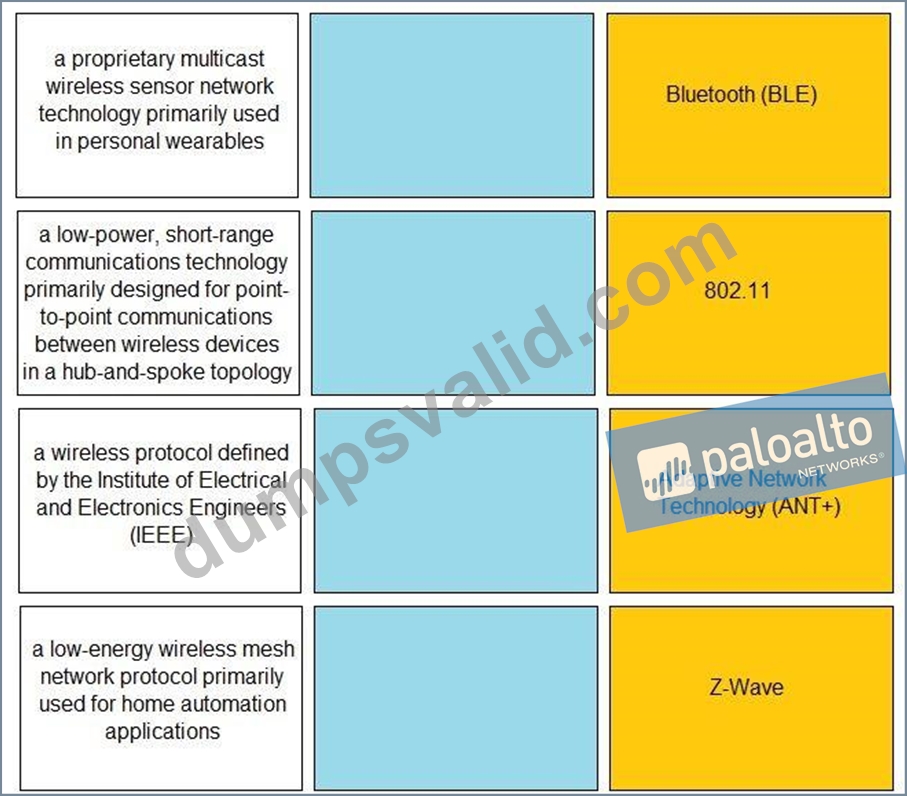
Answer:
Explanation: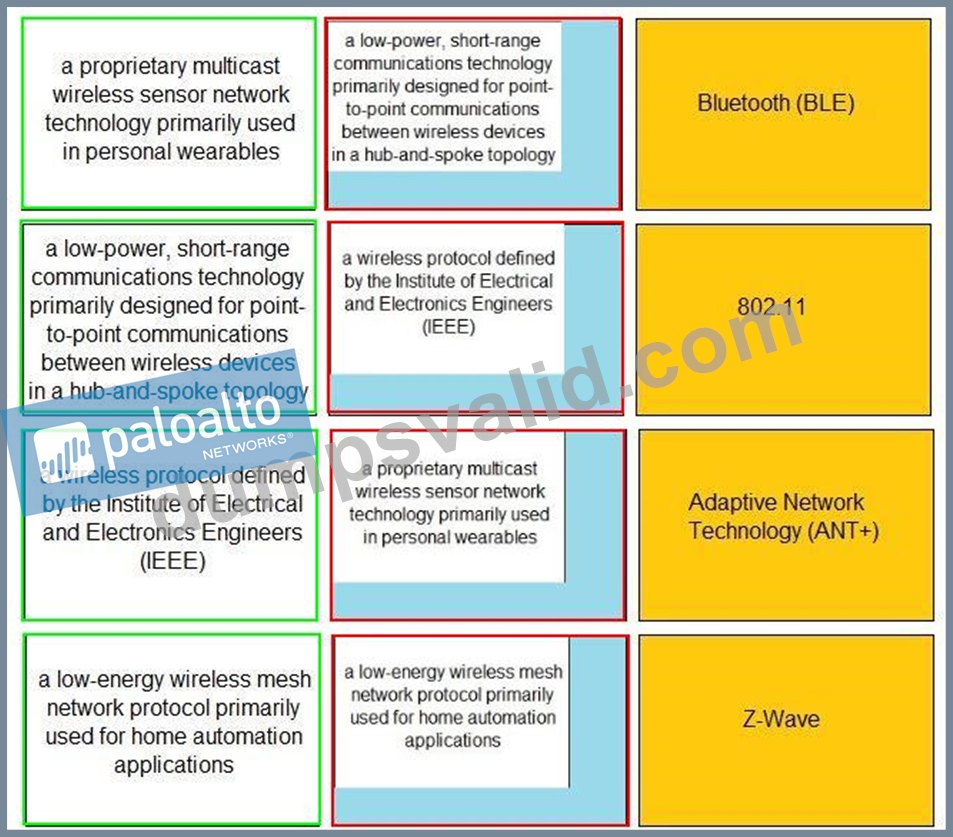
NEW QUESTION # 70
......
Cybersecurity-Practitioner Exam Dumps Contains FREE Real Quesions from the Actual Exam: https://www.dumpsvalid.com/Cybersecurity-Practitioner-still-valid-exam.html
Obtain the Cybersecurity-Practitioner PDF Dumps Get 100% Outcomes Exam Questions For You To Pass: https://drive.google.com/open?id=1fwVHJxb1DM7tl3jjAgiXOqyJNdG22su2