

Latest [Sep 11, 2026] SC-500 Exam Dumps - Valid and Updated Dumps
Free Sales Ending Soon - 100% Valid SC-500 Exam Dumps with 136 Questions
NEW QUESTION # 72
You have an Azure key vault named KV1 that uses role-based access control (RBAC) authorization. KV1 stores database connection strings for an Azure App Service web app named App1.
You enable a firewall on KV1 and allow access to KV1 from only the virtual network that contains App1.
You need to ensure that App1 can retrieve secrets from KV1 without using credentials stored in the application configuration.
What should you create?
- A. an app registration for App1
- B. a private endpoint for KV1
- C. a managed identity for App1
- D. an access policy for KV1
Answer: C
Explanation:
A managed identity enables App1 to authenticate to Azure Key Vault through Microsoft Entra ID without storing or managing application credentials. Because KV1 uses RBAC authorization, the identity must also be assigned an appropriate Key Vault data-plane role, such as Key Vault Secrets User, to retrieve the stored connection strings.
Reference:
https://learn.microsoft.com/en-us/azure/key-vault/general/authentication
https://learn.microsoft.com/en-us/azure/app-service/overview-managed-identity?tabs=portal%2Chttp
https://learn.microsoft.com/en-us/azure/key-vault/general/rbac-guide?tabs=azure-cli
NEW QUESTION # 73
You have a Microsoft Entra tenant that has the following configurations:
- User consent for applications is disabled.
- Only administrators can grant permissions to applications.
You register an application named App1 that uses delegated Microsoft Graph permissions.
You need to configure App1 to meet the following requirements:
- Enable user sign-ins without interactive consent prompts.
- Enable App1 to access Microsoft Graph on behalf of the signed-in
user.
What should you do?
- A. Configure enterprise applications to require user assignment and assign users to App1.
- B. Modify the app registration to use application permissions instead of delegated permissions.
- C. Grant admin consent to App1 for the required delegated permissions.
- D. Add the required delegated Microsoft Graph permissions to the app registration and rely on user consent during sign-in.
Answer: C
Explanation:
Admin consent grants the required delegated Microsoft Graph permissions on behalf of the tenant. App1 can then call Microsoft Graph in the context of a signed-in user without requiring individual users to respond to consent prompts, which is necessary because user consent is disabled.
Reference:
https://learn.microsoft.com/en-us/entra/identity/enterprise-apps/grant-admin-consent?pivots=portal
https://learn.microsoft.com/en-us/entra/identity-platform/quickstart-configure-app-access-web-apis
NEW QUESTION # 74
Hotspot Question
You have an Azure subscription.
You need to create and deploy an Azure policy that meets the following requirements:
- When a new virtual machine is deployed, automatically install a
custom security extension.
- Trigger an autogenerated remediation task for non-compliant virtual
machines to install the extension.
What should you include in the policy? To answer, select the appropriate options in the answer area.
NOTE: Each correct selection is worth one point.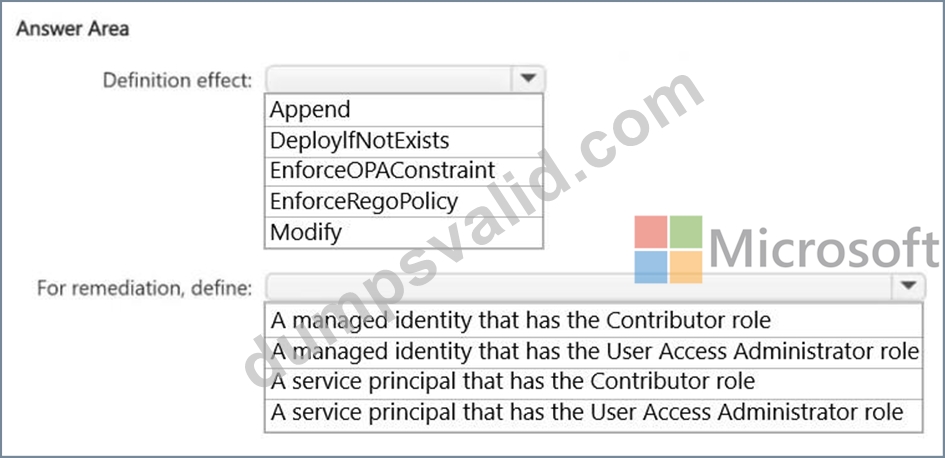
Answer:
Explanation: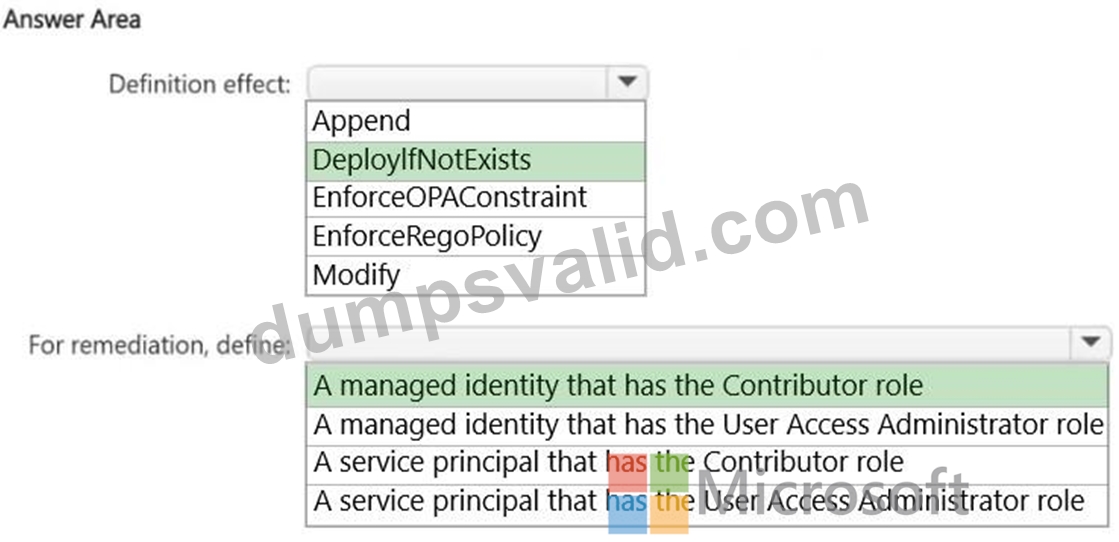
NEW QUESTION # 75
You have a Microsoft Entra tenant that contains the users shown in the following table.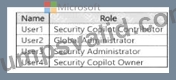
You use Microsoft Security Copilot.
From Microsoft Security Store, User1 attempts to deploy a partner built agent named Agent1 and reports that the Get agent option is unavailable.
You need to identify whether Agent1 can run in Security Copilot successfully. The solution must follow the principle of least privilege.
How should you complete the deployment? To answer, select the appropriate options in the answer area.
NOTE: Each correct selection is worth one point.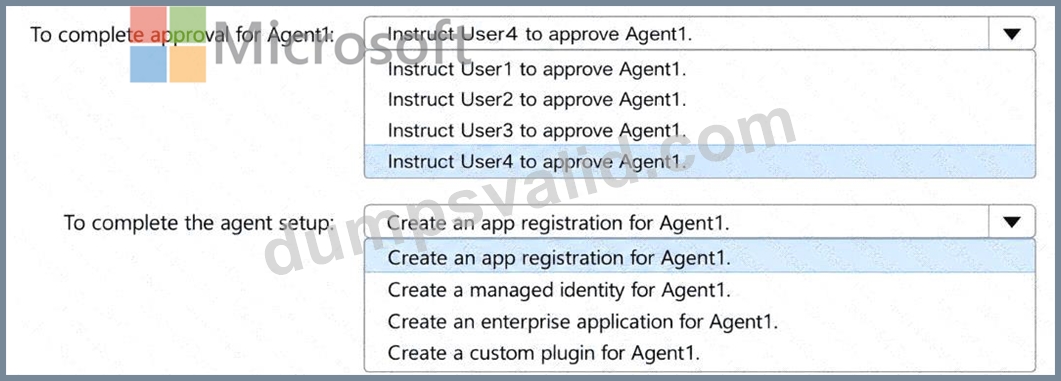
Answer:
Explanation: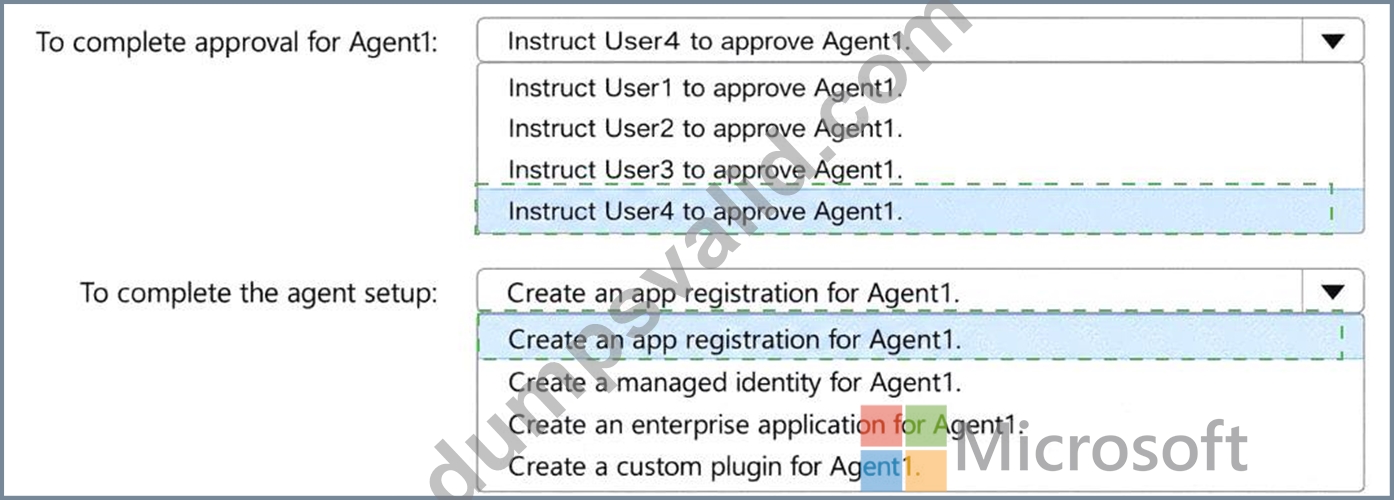
Explanation:
To complete approval for Agent1: Instruct User4 to approve Agent1; To complete the agent setup:
Create an app registration for Agent1
Security Store partner-built agents require organization-level approval before contributors can acquire and use them. User4 is the Security Copilot Owner, so User4 is the least-privilege approver among the listed accounts.
The agent also needs an app registration so the agent identity and permissions can be represented through Microsoft Entra. Global Administrator could approve many things, but using the Security Copilot Owner avoids unnecessary tenant-wide privilege for this operational approval. This answer also follows operational scalability. Microsoft security architecture favors policy-driven deployment, agentless assessment, managed identities, and Defender workload plans where possible. Those mechanisms reduce manual configuration while keeping enforcement tied to the resource type, which is why the selected choice is stronger than manual or after-the-fact alternatives. The result is a direct exam-style implementation choice: it changes the required security behavior without relying on unrelated monitoring, manual cleanup, or excessive privilege. Official Microsoft source/topic: SC-500 Study Guide > Microsoft Security Copilot agents; Microsoft Learn > Security Store agent approval and app registration.
NEW QUESTION # 76
You have an Azure key vault named KV1 that uses role-based access control (RBAC) authorization KV1 stores database connection strings for an Azure App Service web app named App1.
You enable a firewall on KV1 and allow access to KV1 from only the virtual network that contains App1.
You need to ensure that App1 can retrieve secrets from KV1 without using credentials stored in the application configuration.
What should you create?
- A. An access policy for KV1
- B. An app registration for App1
- C. A managed identity for App1
- D. A private endpoint for KV1
Answer: C
NEW QUESTION # 77
You have an Azure SQL Database logical server named Server1 that contains multiple databases.
The databases contain legacy SQL authentication logins that must no longer be usable for sign-in but must NOT be removed from the databases.
You need to ensure that SQL authentication is denied for connections.
What should you do?
- A. Run CREATE USER ... FROM EXTERNAL PROVIDER on each database.
- B. Assign the SQL Server Contributor role to Server1.
- C. Create a Conditional Access policy.
- D. Enable Microsoft Entra-only authentication for Server1.
Answer: D
Explanation:
Microsoft Entra-only authentication at the logical server level disables SQL authentication for all databases on that server while leaving existing SQL principals in place. That matches the requirement to deny SQL authentication without removing legacy logins. Creating external-provider users adds Entra users; it does not block SQL logins. Conditional Access can govern Entra sign-ins but cannot disable SQL authentication. SQL Server Contributor is an Azure management role, not an authentication mode. The exam objective emphasizes practical identity enforcement rather than cosmetic configuration. A valid answer must identify who authenticates, what permission is granted, where the scope is applied, and whether the method continues to work without passwords or secrets. That is why the selected answer is preferred over broader administrative roles or unrelated access settings. The result is a direct exam-style implementation choice: it changes the required security behavior without relying on unrelated monitoring, manual cleanup, or excessive privilege.
Official Microsoft source/topic: SC-500 Study Guide > Azure SQL platform security; Microsoft Learn > Microsoft Entra-only authentication.
NEW QUESTION # 78
You have an Azure key vault named KV1.
You have an Azure App Service web app named App1. App1 is integrated with a virtual network named VNet1 that is linked to an Azure Private DNS zone. App1 accesses secrets stored in KV1.
You need to configure KV1 to meet the following requirements:
- App1 must access the secrets by using a private IP address on VNet1.
- Requests from outside VNet1 must be denied.
Which two actions should you perform for KV1? Each correct answer presents part of the solution.
NOTE: Each correct selection is worth one point.
- A. Create an access policy.
- B. Add the IP addresses of App1.
- C. Create a private endpoint.
- D. Disable public access.
Answer: C,D
Explanation:
To meet your requirements, you must create a Private Endpoint for the Azure Key Vault, configure its firewall to deny public access, and link the Key Vault's private DNS zone to your virtual network (VNet). Because your Azure App Service is already VNet-integrated, these steps ensure all traffic to the Key Vault routes securely over your private IP space.
Reference:
https://learn.microsoft.com/en-us/azure/key-vault/general/private-link-service
NEW QUESTION # 79
You have a Microsoft Sentinel workspace named Workspace1.
You have 100 on-premises servers that run Linux and have the Azure Monitor Agent installed.
You need to collect Syslog events from the Linux servers. The solution must meet the following requirements:
- Ensure that filtering occurs before data is written to Workspace1.
- Reduce ingestion costs by excluding low-value Syslog messages.
What should you include in the solution?
- A. an Advanced Security Information Model (ASIM) parser
- B. an analytics rule
- C. a data collection rule (DCR)
- D. a table-level filter and split transformation
Answer: C
Explanation:
A data collection rule defines the Syslog facilities and severity levels that the Azure Monitor Agent collects from the Linux servers and sends to Workspace1. By excluding low-value messages in the rule, unwanted events are filtered before storage in the Log Analytics workspace, reducing data ingestion costs.
Reference:
https://learn.microsoft.com/en-us/azure/azure-monitor/vm/data-collection-syslog
https://learn.microsoft.com/en-us/azure/sentinel/connect-cef-syslog-ama?tabs=portal
NEW QUESTION # 80
You have a virtual network named VNet1 that contains a subnet named Subnet1 and a virtual machine named VM1. VM1 uses only dynamic IP addresses from Subnet1.
You have an Azure key vault named KV1.
You enable a firewall on KV1 and allow access to KV1 from only select virtual networks and IP addresses.
VM1 receives 403 errors when it attempts to access KV1.
You need to enable VM1 to access KV1, while maintaining the current restrictions on KV1.
What should you do?
- A. Create a routing rule on Subnet1.
- B. Add a Microsoft.KeyVault service endpoint for Subnet1.
- C. Add the current IPv4 address of VM1 to the firewall allowlist of KV1.
- D. Allow trusted Microsoft services to bypass the firewall on KV1.
Answer: B
Explanation:
To resolve the 403 error while maintaining the current firewall restrictions, you must add the virtual machine's subnet to the Azure Key Vault firewall rules and ensure the Microsoft.KeyVault service endpoint is enabled on that subnet.
Because the virtual machine uses dynamic IP addresses, you cannot safely whitelist individual IP addresses in the firewall. Allowing the entire subnet securely grants access to the virtual machine while maintaining the strict perimeter.
Reference:
https://learn.microsoft.com/en-us/azure/key-vault/general/network-security
NEW QUESTION # 81
Case Study 2 - Fabrikam, Inc.
Overview
Fabrikam, Inc. is a consulting company. The company has a main office in New York City and branch offices in Amsterdam and Singapore.
Existing Environment. Network environment
The on-premises network contains a datacenter in each office.
Existing Environment. Cloud environment
Fabrikam has two Azure subscriptions named Sub1 and Sub2 and a Microsoft 365 subscription that includes Microsoft 365 E5 licenses.
All the subscriptions are linked to a Microsoft Entra tenant named fabrikam.com that contains the identities shown in the following table.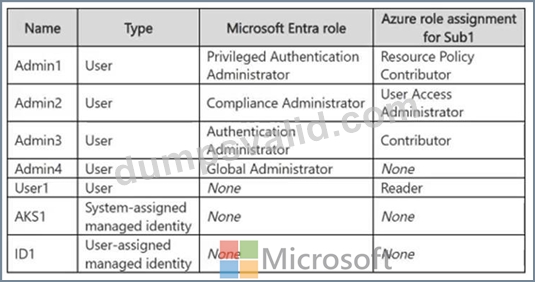
The tenant contains the groups shown in the following table.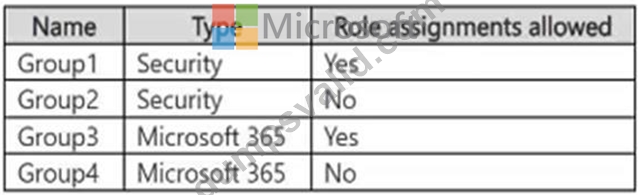
All devices are enrolled in Microsoft Intune.
Existing Environment. Sub1 Resources
Sub1 contains a resource group named RG1 that contains the resources shown in the following table.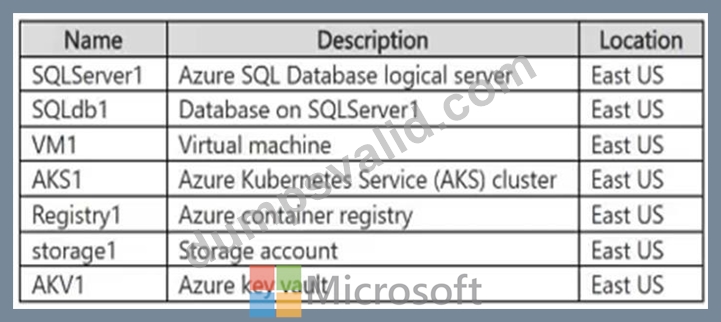
SQLServer1 uses Microsoft SQL Server authentication.
Sub1 has an Azure Web Application Firewall (WAF) named WAF1 that has the following types of rule sets:
- Bot Manager 1.1
- Azure-managed Default Rule Set (DRS)
Sub1 has the following compliance standards assigned in Microsoft Defender for Cloud:
- NIST SP 800-53 Rev. 4
- Microsoft cloud security benchmark (MCSB)
- System and Organization Controls (SOC) 2 Type 2
Existing Environment. Sub2 Resources
Sub2 contains a resource group named RG2.
Planned Changes and Requirements. Planned Changes
Fabrikam plans to implement the following changes:
- Deploy the following key vaults to RG1:
* AKV2 in the West Europe Azure region
* AKV3 in the Central US Azure region
* AKV4 in the East US Azure region
- Deploy the following key vaults to RG2:
* AKV5 in the East US region
- Configure VM1 to read data from storage1.
- Create function apps that have the following hosting plans:
* Fa1: Flex Consumption hosting plan
* Fa2: Consumption hosting plan
* Fa3: Dedicated hosting plan
- For WAF1, implement rate limiting rules based on the request
location.
- Enable the NIST SP 800-53 Rev. 5 compliance standard in Defender for
Cloud.
- Create a new storage account named storage2 that supports Azure Table storage.
- Enforce multifactor authentication (MFA) when database administrators access SQLdb1.
- Implement ExpressRoute circuits to the on-premises network as shown
in the following table.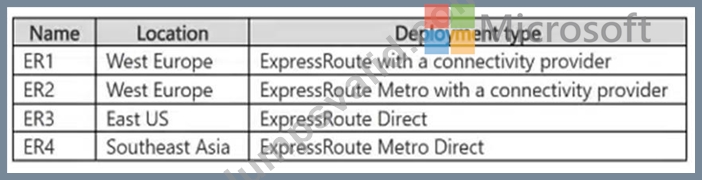
- For RG1, create a new Privileged Identity Management (PIM) eligible role assignment that assigns the Contributor role to supported groups.
Planned Changes and Requirements. Technical Requirements
Fabrikam has the following technical requirements:
- If VM1 is deleted, the permissions for VM1 must be removed
automatically.
- The AKS1 managed identity must only be able to pull images from
Registry1.
- The ID1 managed identity must be able to push images to and pull
images from Registry1.
- All the data in the storage accounts must be encrypted by using
Fabrikam-managed keys.
- All outbound traffic from the function apps to the on-premises
network must use ExpressRoute circuits.
- ExpressRoute connectivity between the on-premises network and the
Azure environment must be encrypted by using Layer 2 or Layer 3
encryption.
You need to implement the planned change for storage2. The solution must meet the technical requirements for storage encryption. What should you do?
- A. Enable purge protection for storage2.
- B. Configure storage2 to use an account encryption key.
- C. Assign an Azure role-based access control (Azure RBAC) role to storage2.
- D. Create an encryption scope in storage2.
Answer: B
Explanation:
Because storage2 must support Azure Table storage, it must be created to use an encryption key scoped to the storage account. Azure Table storage can then be encrypted by using a Fabrikam- managed customer-managed key. Encryption scopes apply to Blob storage and do not meet the requirement for Table storage encryption.
Reference:
https://learn.microsoft.com/en-us/azure/storage/common/account-encryption-key-create?tabs=portal
https://learn.microsoft.com/en-us/azure/storage/blobs/encryption-scope-overview
NEW QUESTION # 82
Case Study 2 - Fabrikam, Inc.
Overview
Fabrikam, Inc. is a consulting company. The company has a main office in New York City and branch offices in Amsterdam and Singapore.
Existing Environment. Network environment
The on-premises network contains a datacenter in each office.
Existing Environment. Cloud environment
Fabrikam has two Azure subscriptions named Sub1 and Sub2 and a Microsoft 365 subscription that includes Microsoft 365 E5 licenses.
All the subscriptions are linked to a Microsoft Entra tenant named fabrikam.com that contains the identities shown in the following table.
The tenant contains the groups shown in the following table.
All devices are enrolled in Microsoft Intune.
Existing Environment. Sub1 Resources
Sub1 contains a resource group named RG1 that contains the resources shown in the following table.
SQLServer1 uses Microsoft SQL Server authentication.
Sub1 has an Azure Web Application Firewall (WAF) named WAF1 that has the following types of rule sets:
- Bot Manager 1.1
- Azure-managed Default Rule Set (DRS)
Sub1 has the following compliance standards assigned in Microsoft Defender for Cloud:
- NIST SP 800-53 Rev. 4
- Microsoft cloud security benchmark (MCSB)
- System and Organization Controls (SOC) 2 Type 2
Existing Environment. Sub2 Resources
Sub2 contains a resource group named RG2.
Planned Changes and Requirements. Planned Changes
Fabrikam plans to implement the following changes:
- Deploy the following key vaults to RG1:
AKV2 in the West Europe Azure region
AKV3 in the Central US Azure region
AKV4 in the East US Azure region
- Deploy the following key vaults to RG2:
AKV5 in the East US region
- Configure VM1 to read data from storage1.
- Create function apps that have the following hosting plans:
Fa1: Flex Consumption hosting plan
Fa2: Consumption hosting plan
Fa3: Dedicated hosting plan
- For WAF1, implement rate limiting rules based on the request
location.
- Enable the NIST SP 800-53 Rev. 5 compliance standard in Defender for
Cloud.
- Create a new storage account named storage2 that supports Azure Table storage.
- Enforce multifactor authentication (MFA) when database administrators access SQLdb1.
- Implement ExpressRoute circuits to the on-premises network as shown
in the following table.
- For RG1, create a new Privileged Identity Management (PIM) eligible role assignment that assigns the Contributor role to supported groups.
Planned Changes and Requirements. Technical Requirements
Fabrikam has the following technical requirements:
- If VM1 is deleted, the permissions for VM1 must be removed
automatically.
- The AKS1 managed identity must only be able to pull images from
Registry1.
- The ID1 managed identity must be able to push images to and pull
images from Registry1.
- All the data in the storage accounts must be encrypted by using
Fabrikam-managed keys.
- All outbound traffic from the function apps to the on-premises
network must use ExpressRoute circuits.
- ExpressRoute connectivity between the on-premises network and the
Azure environment must be encrypted by using Layer 2 or Layer 3
encryption.
You need to implement the planned change for VM1 to access storage. The solution must meet the technical requirements. What should you do first?
- A. Configure a system-assigned managed identity on VM1.
- B. Configure federated identity credentials for ID1.
- C. Add a role assignment condition to storage1.
- D. Assign ID1 to VM1.
- E. Assign the Storage Blob Data Reader role to storage1.
Answer: A
Explanation:
You should use a system-assigned managed identity.
System-assigned identities are tightly coupled to the lifecycle of the Azure resource they are attached to. When you delete the virtual machine, the system-assigned identity is automatically deleted from Microsoft Entra ID, ensuring that all associated permissions are automatically revoked. In contrast, user-assigned managed identities are independent standalone resources and must be manually deleted.
Scenario:
Fabrikam plans to implement the following changes:
Configure VM1 to read data from storage1.
Fabrikam has the following technical requirements:
If VM1 is deleted, the permissions for VM1 must be removed automatically.
ID1 is a user-assigned managed identity.
Reference:
https://learn.microsoft.com/en-us/azure/container-apps/managed-identity
NEW QUESTION # 83
Case Study 2 - Fabrikam, Inc.
Overview
Fabrikam, Inc. is a consulting company. The company has a main office in New York City and branch offices in Amsterdam and Singapore.
Existing Environment. Network environment
The on-premises network contains a datacenter in each office.
Existing Environment. Cloud environment
Fabrikam has two Azure subscriptions named Sub1 and Sub2 and a Microsoft 365 subscription that includes Microsoft 365 E5 licenses.
All the subscriptions are linked to a Microsoft Entra tenant named fabrikam.com that contains the identities shown in the following table.
The tenant contains the groups shown in the following table.
All devices are enrolled in Microsoft Intune.
Existing Environment. Sub1 Resources
Sub1 contains a resource group named RG1 that contains the resources shown in the following table.
SQLServer1 uses Microsoft SQL Server authentication.
Sub1 has an Azure Web Application Firewall (WAF) named WAF1 that has the following types of rule sets:
- Bot Manager 1.1
- Azure-managed Default Rule Set (DRS)
Sub1 has the following compliance standards assigned in Microsoft Defender for Cloud:
- NIST SP 800-53 Rev. 4
- Microsoft cloud security benchmark (MCSB)
- System and Organization Controls (SOC) 2 Type 2
Existing Environment. Sub2 Resources
Sub2 contains a resource group named RG2.
Planned Changes and Requirements. Planned Changes
Fabrikam plans to implement the following changes:
- Deploy the following key vaults to RG1:
AKV2 in the West Europe Azure region
AKV3 in the Central US Azure region
AKV4 in the East US Azure region
- Deploy the following key vaults to RG2:
AKV5 in the East US region
- Configure VM1 to read data from storage1.
- Create function apps that have the following hosting plans:
Fa1: Flex Consumption hosting plan
Fa2: Consumption hosting plan
Fa3: Dedicated hosting plan
- For WAF1, implement rate limiting rules based on the request
location.
- Enable the NIST SP 800-53 Rev. 5 compliance standard in Defender for
Cloud.
- Create a new storage account named storage2 that supports Azure Table storage.
- Enforce multifactor authentication (MFA) when database administrators access SQLdb1.
- Implement ExpressRoute circuits to the on-premises network as shown
in the following table.
- For RG1, create a new Privileged Identity Management (PIM) eligible role assignment that assigns the Contributor role to supported groups.
Planned Changes and Requirements. Technical Requirements
Fabrikam has the following technical requirements:
- If VM1 is deleted, the permissions for VM1 must be removed
automatically.
- The AKS1 managed identity must only be able to pull images from
Registry1.
- The ID1 managed identity must be able to push images to and pull
images from Registry1.
- All the data in the storage accounts must be encrypted by using
Fabrikam-managed keys.
- All outbound traffic from the function apps to the on-premises
network must use ExpressRoute circuits.
- ExpressRoute connectivity between the on-premises network and the
Azure environment must be encrypted by using Layer 2 or Layer 3
encryption.
Hotspot Question
You need to implement the planned change for the PIM role assignment.
Which users can perform the planned change, and for which groups? To answer, select the appropriate options in the answer area.
NOTE: Each correct selection is worth one point.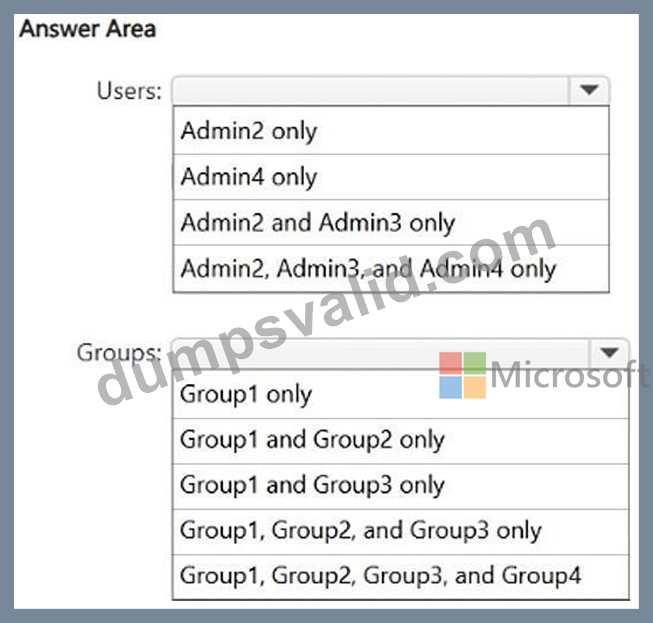
Answer:
Explanation: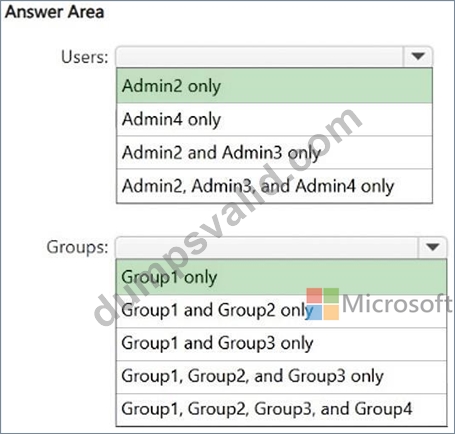
Explanation:
Scenario:
Planned change: For RG1, create a new Privileged Identity Management (PIM) eligible role assignment that assigns the Contributor role to supported groups.
Box 1: Admin2 only
Scenario:
Admin2 has the Microsoft Entra role Compliance administrator, and the Azure role assignment User Access Administrator.
Admin3 has the Microsoft Entra role Authentication administrator, and the Azure role assignment Contributor.
Admin4 has the Microsoft Entra role Global administrator, and no Azure role assignment.
Only Admin2 can perform the required task.
Creating a Privileged Identity Management (PIM) eligible role assignment for Azure requires the ability to write role assignments at the desired scope (like Microsoft.Authorization/roleAssignments/write). This authorization is specifically granted by the Azure User Access Administrator or Owner roles.
Breakdown of the administrators:
Admin2: Has the Azure role User Access Administrator, which permits managing PIM assignments for Azure resources.
Admin3: Has the Azure Contributor role. While Contributor can manage resources, it does not include permissions to assign roles or configure PIM.
Admin4: Is a Global Administrator in Microsoft Entra ID. While Global Administrators can manage Microsoft Entra roles in PIM, they do not automatically have permissions to manage or assign Azure resource roles unless they have been explicitly granted an Azure role like User Access Administrator.
Box 2: Group1 only
Scenario:
Group1 is a security group and role assignment is allowed.
Group2 is a security group and role assignment is not allowed.
Group3 is a Microsoft 365 group and role assignment is allowed.
Group4 is a Microsoft 365 group and role assignment is not allowed.
The Contributor role can be assigned to Group1.To assign a role (like Contributor) to a group in Microsoft Entra (Azure RBAC), the group must be a cloud-only security or Microsoft 365 group that has the isAssignableToRole property explicitly enabled at the time of creation.
Here is the breakdown for each of your groups:
Group1 (Yes): It is a security group, and role assignment is allowed.
Group2 (No): Role assignment is not allowed for this group.
Group3 (No): While it is allowed for assignment, Microsoft 365 groups currently do not support Azure resource roles (only Microsoft Entra directory roles are supported).
Group4 (No): Role assignment is not allowed.
Reference:
https://docs.azure.cn/en-us/entra/id-governance/privileged-identity-management/pim-deployment-plan
NEW QUESTION # 84
Drag and Drop Question
You have an Azure virtual network named VNet1 that contains an AzureBastionSubnet. VNet1 contains a subnet named Subnet1. Subnet1 contains multiple virtual machines.
You plan to deploy Azure Bastion to provide secure RDP access to the virtual machines on Subnet1. You associate a network security group (NSG) named NSG1 to AzureBastionSubnet.
You need to configure rules for NSG1. The solution must meet the following requirements:
- Allow required inbound access to Azure Bastion from the internet.
- Allow user access to the virtual machines by using Azure Bastion.
Which TCP ports should you allow for the NSG1 rules? To answer, drag the appropriate ports to the correct rules. Each port may be used once, more than once, or not at all. You may need to drag the split bar between panes or scroll to view content.
NOTE: Each correct selection is worth one point.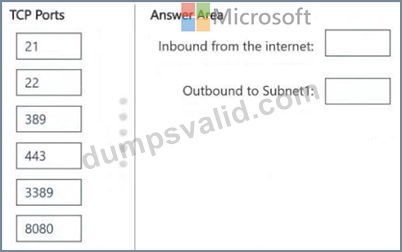
Answer:
Explanation: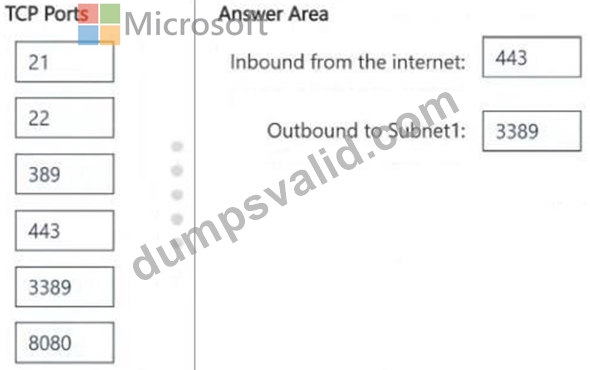
NEW QUESTION # 85
Drag and Drop Question
You have a Bicep file for an Azure Storage account that stores regulated data.
You need to revise the file to meet the following requirements:
- Require HTTPS-only traffic.
- Prevent the storage account key from being exposed in deployment
outputs.
How should you complete the Bicep code? To answer, drag the appropriate values to the correct targets. Each value may be used once, more than once, or not at all. You may need to drag the split bar between panes or scroll to view content.
NOTE: Each correct selection is worth one point.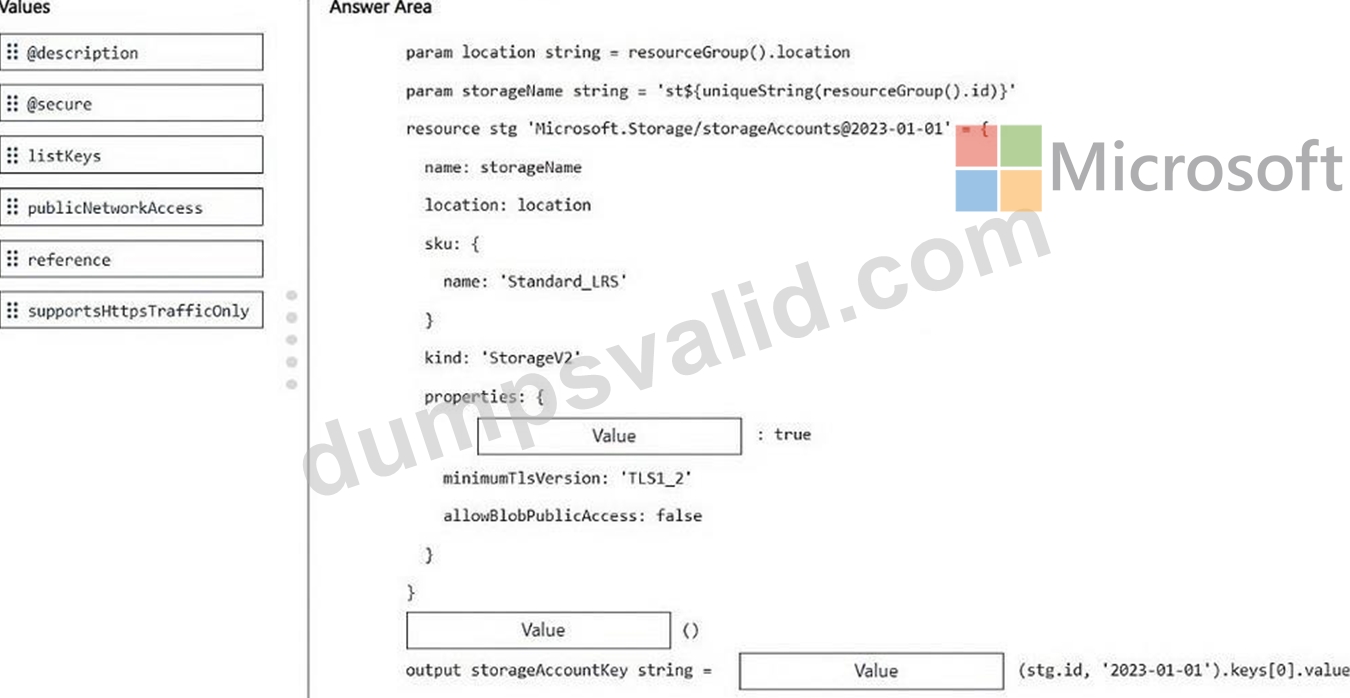
Answer:
Explanation: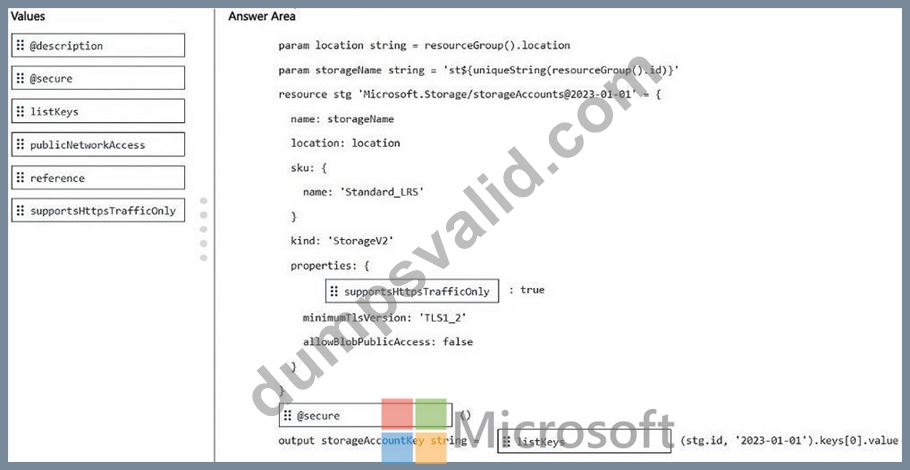
Explanation:
Box 1: supportsHttpsTrafficOnly
Prevents HTTP requests entirely, ensuring data is encrypted in transit.
Box 2: @secure()
The @secure() decorator masks the output value in the Azure deployment history logs and prevents plaintext disclosure.list Box 3: listKeys Dynamically accesses the keys securely at runtime instead of hardcoding sensitive secrets in the template.
Reference:
https://learn.microsoft.com/en-us/azure/azure-resource-manager/bicep/modules
NEW QUESTION # 86
You have multiple Microsoft Security Copilot workspaces.
A user named User1 accesses Security Copilot by using the default workspace.
You create a new workspace named Workspace 1 and assign a capacity to Workspace1.
You plan to route Security Copilot agent traffic to Workspace1.
You need to ensure that User1 can use embedded experiences without errors.
What should you do before switching to Workspace1?
- A. Disassociate the capacity from the default workspace.
- B. Add User1 to Workspace1.
- C. Assign User1 the Security Operator role in Microsoft Entra.
- D. Create a new capacity for Workspace1.
Answer: B
Explanation:
Security Copilot workspaces have membership and capacity associations. Before routing embedded experience traffic to Workspace1, User1 must be granted access to that workspace. Assigning a generic Security Operator role in Microsoft Entra does not make the user a member of the Security Copilot workspace. Disassociating capacity from the default workspace or creating more capacity does not resolve the user-access error. This domain is tested through precise scope control: tenant, subscription, resource, application, and data-plane authorization are not interchangeable. The correct choice applies the smallest identity or governance control that enforces the stated requirement. Options that only add users, create registrations, or provide broad administrator access fail because they do not directly enforce the requested access behavior. The result is a direct exam-style implementation choice: it changes the required security behavior without relying on unrelated monitoring, manual cleanup, or excessive privilege. Official Microsoft source/topic: SC-500 Study Guide > Security Copilot workspaces; Microsoft Learn > workspace access and capacity.
NEW QUESTION # 87
Case Study 2 - Fabrikam, Inc.
Overview
Fabrikam, Inc. is a consulting company. The company has a main office in New York City and branch offices in Amsterdam and Singapore.
Existing Environment. Network environment
The on-premises network contains a datacenter in each office.
Existing Environment. Cloud environment
Fabrikam has two Azure subscriptions named Sub1 and Sub2 and a Microsoft 365 subscription that includes Microsoft 365 E5 licenses.
All the subscriptions are linked to a Microsoft Entra tenant named fabrikam.com that contains the identities shown in the following table.
The tenant contains the groups shown in the following table.
All devices are enrolled in Microsoft Intune.
Existing Environment. Sub1 Resources
Sub1 contains a resource group named RG1 that contains the resources shown in the following table.
SQLServer1 uses Microsoft SQL Server authentication.
Sub1 has an Azure Web Application Firewall (WAF) named WAF1 that has the following types of rule sets:
- Bot Manager 1.1
- Azure-managed Default Rule Set (DRS)
Sub1 has the following compliance standards assigned in Microsoft Defender for Cloud:
- NIST SP 800-53 Rev. 4
- Microsoft cloud security benchmark (MCSB)
- System and Organization Controls (SOC) 2 Type 2
Existing Environment. Sub2 Resources
Sub2 contains a resource group named RG2.
Planned Changes and Requirements. Planned Changes
Fabrikam plans to implement the following changes:
- Deploy the following key vaults to RG1:
AKV2 in the West Europe Azure region
AKV3 in the Central US Azure region
AKV4 in the East US Azure region
- Deploy the following key vaults to RG2:
AKV5 in the East US region
- Configure VM1 to read data from storage1.
- Create function apps that have the following hosting plans:
Fa1: Flex Consumption hosting plan
Fa2: Consumption hosting plan
Fa3: Dedicated hosting plan
- For WAF1, implement rate limiting rules based on the request
location.
- Enable the NIST SP 800-53 Rev. 5 compliance standard in Defender for
Cloud.
- Create a new storage account named storage2 that supports Azure Table storage.
- Enforce multifactor authentication (MFA) when database administrators access SQLdb1.
- Implement ExpressRoute circuits to the on-premises network as shown
in the following table.
- For RG1, create a new Privileged Identity Management (PIM) eligible role assignment that assigns the Contributor role to supported groups.
Planned Changes and Requirements. Technical Requirements
Fabrikam has the following technical requirements:
- If VM1 is deleted, the permissions for VM1 must be removed
automatically.
- The AKS1 managed identity must only be able to pull images from
Registry1.
- The ID1 managed identity must be able to push images to and pull
images from Registry1.
- All the data in the storage accounts must be encrypted by using
Fabrikam-managed keys.
- All outbound traffic from the function apps to the on-premises
network must use ExpressRoute circuits.
- ExpressRoute connectivity between the on-premises network and the
Azure environment must be encrypted by using Layer 2 or Layer 3
encryption.
You need to implement the planned change for WAF1. The solution must minimize administrative effort. What should you do?
- A. Modify the Azure-managed DRS.
- B. Create an Azure policy.
- C. Add a custom rule.
- D. Modify the Bot Manager 1.1 rule set.
Answer: C
Explanation:
To implement location-based rate limiting rules on an Azure Web Application Firewall (WAF) using the Bot Manager 1.1 and Default Rule Set (DRS), you must create a custom rule with a rule type set to "Rate limit" and configure a "Geo location" match condition.
Scenario:
Sub1 has an Azure Web Application Firewall (WAF) named WAF1 that has the following types of rule sets: Bot Manager 1.1, Azure-managed Default Rule Set (DRS) For WAF1, implement rate limiting rules based on the request location.
Reference:
https://learn.microsoft.com/en-us/azure/web-application-firewall/ag/rate-limiting-overview
NEW QUESTION # 88
Hotspot Question
You are implementing security controls for an Azure Storage account by using infrastructure as code (IaC).
You deploy the following Bicep code.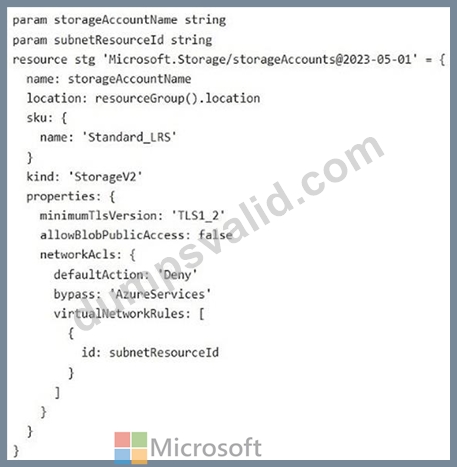
For each of the following statements, select Yes if the statement is true. Otherwise, select No.
NOTE: Each correct selection is worth one point.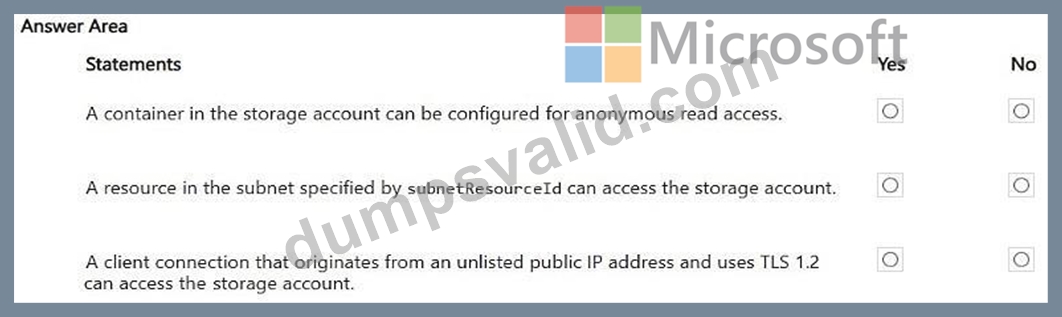
Answer:
Explanation: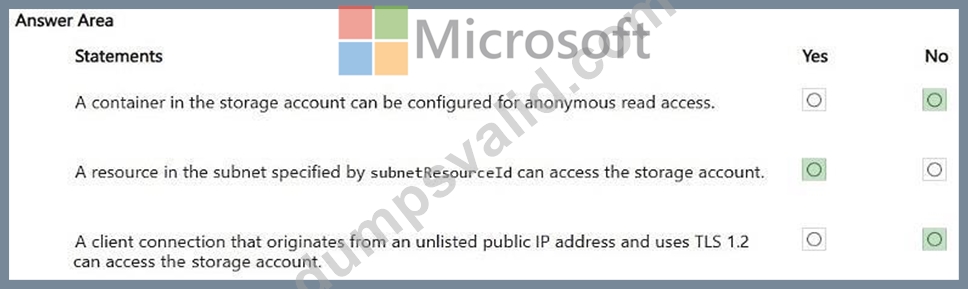
Explanation:
Box 1: No
No, a container in this storage account cannot be successfully configured for anonymous read access Why Anonymous Access is Blocked Even if you try to change the access policy settings at the individual container level, public anonymous access is fully prevented by two explicit configurations in your Bicep script:
allowBlobPublicAccess: false
This property acts as a strict, account-level security master switch.
Setting this to false overrides any container-level configurations. It completely blocks all anonymous public read access to all blobs and containers within this storage account.
defaultAction: 'Deny' (within networkAcls)This configuration enables the Azure Storage Firewall.
It blocks all incoming traffic by default, except for requests originating from the specific subnet listed under virtualNetworkRules or trusted AzureServices.
Because anonymous public requests come from the public internet (and not your private subnet), they will be automatically blocked by the firewall.
Box 2: Yes
Yes, a resource in the specified subnet can access the storage account
The provided Bicep template configures Azure Storage network security controls that explicitly permit this access route:defaultAction: 'Deny': This setting locks down the storage account, blocking all public internet traffic and traffic from unauthorized networks by default.
virtualNetworkRules: This block acts as a specific firewall exception list. By including the block
{ id: subnetResourceID }, you explicitly allow traffic originating from that exact subnet to bypass the default deny rule and connect to the storage account.
Box 3: No
No, a client connection originating from an unlisted public IP address cannot access the storage account.
Why Access is Denied
Default Network Action is Blocked: The Bicep configuration sets defaultAction: 'Deny' inside the networkAcls block. This establishes a firewall rule that blocks all network traffic by default unless explicitly allowed.
IP Address is Unlisted: Because the public IP address is unlisted, it does not match any allowed public IP rules (ipRules) in the configuration.
Virtual Network Restriction: The only network traffic allowed to bypass the firewall is traffic coming from the specific subnet defined in virtualNetworkRules and trusted AzureServices (via the bypass property).
TLS Version is Irrelevant Here: While the connection successfully uses TLS 1.2 (satisfying the minimumTlsVersion: 'TLS1_2' requirement), it fails the primary network firewall check first.
NEW QUESTION # 89
......
SC-500 Exam Dumps - 100% Marks In SC-500 Exam: https://www.dumpsvalid.com/SC-500-still-valid-exam.html