

Free May-2026 UPDATED The Open Group OGEA-103 Exam Questions & Answer
Latest Success Metrics For Actual OGEA-103 Exam Realistic Dumps
The Open Group OGEA-103: TOGAF Enterprise Architecture Combined Part 1 and Part 2 exam is a comprehensive assessment designed to test an individual's knowledge and understanding of the concepts and principles of enterprise architecture. It is a combination of two exams, Part 1 and Part 2, which together cover the entire TOGAF framework. OGEA-103 exam is designed for enterprise architects, IT professionals, and anyone involved in enterprise architecture development.
The Open Group OGEA-103 (TOGAF Enterprise Architecture Combined Part 1 and Part 2) Certification Exam is a globally recognized certification for enterprise architects. TOGAF Enterprise Architecture Combined Part 1 and Part 2 Exam certification exam combines both Part 1 and 2 of the TOGAF Enterprise Architecture framework. The TOGAF framework is a widely used approach for developing and managing enterprise architecture. It provides a common language, methodology, and tools for enterprise architecture development and management.
NEW QUESTION # 94
What are the following activities part or?
* Initial risk assessment
* Risk mitigation and residual risk assessment
* Risk monitoring
- A. Phase A
- B. Security Architecture
- C. Risk Management
- D. Phase C
Answer: C
Explanation:
Explanation
The following activities are part of Risk Management:
Initial risk assessment
Risk mitigation and residual risk assessment
Risk monitoring
Risk Management is the process of identifying, assessing, and responding to risks that may affect the achievement of the enterprise's objectives. Risk Management involves balancing positive and negative outcomes resulting from the realization of either opportunities or threats. Reference: The TOGAF Standard | The Open Group Website, Section 3.3.3 Risk Management.
NEW QUESTION # 95
Complete the sentence The TOGAF standard covers the development of four architecture domains. Business. Data, Technology and__________________.
- A. Application
- B. Segment
- C. Capability
- D. Transition
Answer: A
Explanation:
The TOGAF standard covers the development of four architecture domains: Business, Data, Technology and Application. These domains represent different aspects of an enterprise's architecture and provide a consistent way of describing, analyzing, and designing them. Reference: The TOGAF® Standard | The Open Group Website, Section 2.2 Architecture Development Method (ADM).
NEW QUESTION # 96
Complete the sentence. ______ can be used to explain how generic solutions can be leveraged and specialized to meet the needs of an organization.
- A. The TOGAF ADM
- B. The Enterprise Continuum
- C. The Architecture Repository
- D. The Solutions Landscape
Answer: B
Explanation:
Comprehensive and Detailed In-Depth Explanation from Expert in Enterprise Architecture, guiding in TOGAF and ArchiMate:
The Enterprise Continuum is a TOGAF concept that provides a logical classification mechanism for architecture and solution assets, ranging from:
Generic, industry-wide solutions
To organization-specific architectures and implementations
It explains:
How generic architectures and solutions are adapted, specialized, and reused The relationship between Foundation, Common Systems, Industry, and Organization-Specific assets Why Option D is correct:
The Enterprise Continuum explicitly describes how generic solutions are leveraged and specialized to meet enterprise-specific needs.
Why the other options are incorrect:
A . Architecture Repository: Stores assets but does not explain specialization.
B . Solutions Landscape: Describes deployed solutions, not classification or specialization.
C . TOGAF ADM: A development method, not a classification concept.
NEW QUESTION # 97
Please read this scenario prior to answering the question
You are the Lead Enterprise Architect at a major agribusiness company. The company's main annual harvest is lentils, a highly valued food grown worldwide. The lentil parasite, broomrape, has been an increasing concern for many years and is now becoming resistant to chemical controls. In addition, changes in climate favor the propagation and growth of the parasite. As a result, the parasite cannot realistically be exterminated, and it has become pandemic, with lentil yields falling globally.
The CEO appreciates the seriousness of the situation and has set out a change in direction that is effectively a new business for the company. There are opportunities for new products, and new markets. The company will use the fields for another harvest and will cease to process third-party lentils. Thus, the target market will change, and the end-products will be different and more varied. This is a major decision and the CEO has stated a desire to repurpose rather than replace so as to manage the risks and limit the costs.
The company has a mature Enterprise Architecture practice based in its headquarters and uses the TOGAF standard as the method and guiding framework. The practice has an established Architecture Capability, and uses iteration for architecture development. The CIO is the sponsor of the activity.
The CIO has assigned the Enterprise Architecture team to this activity. At this stage there is no shared vision, or requirements.
Refer to the scenario
You have been asked to propose the best approach for architecture development to realize the CEO's change in direction for the company.
Based on the TOGAF standard which of the following is the best answer?
- A. You propose that the team focus on architecture definition, with emphasis on definingthe change parameters to support this new business strategy that the CEO hasidentified. Once understood, the team will be in the best position to identify therequirements, drivers, issues, and constraints for the change. You would ensure that thearchitecture development addresses non-functional requirements to assure that thetarget architecture is robust and secure.
- B. You propose that this engagement define the baseline Technology Architecture first inorder to assess the current infrastructure capacity and capability for the company. Thenthe focus should be on transition planning and incremental architecture deployment.This will identify requirements to ensure that the projects are sequenced in an optimalfashion so as to realize the change.
- C. You propose that the team focus its iteration cycles on architecture development bygoing through the architecture definition phases (B-D) with a baseline first approach.This will support the change in direction as stated by the CEO. It will ensure that thechange can be defined in a structured manner and address the requirements needed torealize the change.
- D. You propose that the priority is to understand and bring structure to the definition of thechange. The team should focus iteration cycles on a baseline first approach toarchitecture development, and then transition planning. This will identify what needs tochange in order to transition from the baseline to the target, and can be used to work outin detail what the shared vision is for the change.
Answer: D
Explanation:
Based on the TOGAF standard, this answer is the best approach for architecture development to realize the CEO's change in direction for the company. The reason is as follows:
The scenario describes a major business transformation that requires a clear understanding of the current and future states of the enterprise, as well as the gaps and opportunities for change. Therefore, the priority is to understand and bring structure to the definition of the change, rather than focusing on the implementation details or the technology aspects.
The team should use the TOGAF ADM as the method and guiding framework for architecture development, and adapt it to suit the specific needs and context of the enterprise. The team should also leverage the existing Architecture Capability and the Architecture Repository to reuse and integrate relevant architecture assets and resources.
The team should focus iteration cycles on a baseline first approach to architecture development, which means starting with the definition of the Baseline Architecture in each domain (Business, Data, Application, and Technology), and then defining the Target Architecture in each domain. This will help to identify the current and desired states of the enterprise, and to perform a gap analysis to determine what needs to change in order to achieve the business goals and objectives.
The team should then focus on transition planning, which involves identifying and prioritizing the work packages, projects, and activities that will deliver the change. The team should also create an Architecture Roadmap and an Implementation and Migration Plan that will guide the execution and governance of the change.
The team should use the Architecture Vision phase and the Requirements Management phase to work out in detail what the shared vision is for the change, and to capture and validate the stakeholder requirements and expectations. The team should also use the Architecture Governance framework to ensure the quality, consistency, and compliance of the architecture work.
The TOGAF Standard, Version 9.2 - Architecture Development Method : The TOGAF Standard, Version 9.2 - Architecture Vision : The TOGAF Standard, Version 9.2 - Requirements Management : [The TOGAF Standard, Version 9.2 - Architecture Governance]
NEW QUESTION # 98
Which statement about Requirements Management is most correct?
- A. Stakeholder requirements are captured once in Phase A and managed throughout the ADM cycle
- B. Requirements Management and stakeholder engagement are placed at the center of architecture development
- C. The purpose of Requirements Management is to process change requests
- D. Requirements Management is a step of all ADM Phases
Answer: B
Explanation:
Explanation
This statement about Requirements Management is most correct because it reflects the central role of Requirements Management and stakeholder engagement in the ADM cycle. Requirements Management is not a step of all ADM Phases, but rather an ongoing process that ensures that all relevant requirements are elicited, analyzed, prioritized, and addressed throughout the architecture development and transition. Stakeholder engagement is also a continuous activity that involves identifying, communicating, and managing stakeholder expectations and concerns. Reference: The TOGAF Standard | The Open Group Website, Section 3.1 Introduction to the ADM.
NEW QUESTION # 99
Complete the sentence The purpose of the Preliminary Phase is to_____________.
- A. define the enterprise strategy
- B. identify the stakeholders and their requirements
- C. architect an Enterprise Architecture Capability
- D. describe the target architecture
Answer: C
Explanation:
The purpose of the Preliminary Phase is to architect an Enterprise Architecture Capability that meets the needs and expectations of the enterprise's stakeholders and supports and enables subsequent phases of architecture development and transition. This phase involves defining the scope, principles, framework, and governance for the Enterprise Architecture Capability. Reference: The TOGAF® Standard | The Open Group Website, Section 3.2 Preliminary Phase.
NEW QUESTION # 100
Which of the following best describes purpose of the Business Scenarios?
- A. To identify and understand requirements
- B. To guide decision making throughout the enterprise
- C. To identify risk when implementing an architecture project
- D. To catch errors in a project architecture early
Answer: A
Explanation:
Business scenarios are a technique for capturing, clarifying, and communicating the functional and non-functional requirements of a system. Business scenarios describe the business environment, the actors involved, the desired outcomes, and the processes or rules that govern the behavior of the system. Business scenarios are useful for ensuring that the architecture addresses the real needs and concerns of the stakeholders, and for validating and testing the architecture against expected situations. Business scenarios are developed in Phase A: Architecture Vision of the ADM cycle, and refined and updated throughout the other phases3 Reference: 3: The TOGAF Standard, Version 9.2, Part III: ADM Guidelines and Techniques, Chapter 26: Business Scenarios : The TOGAF Standard, Version 9.2, Part II: Architecture Development Method (ADM), Chapter 18: Phase A: Architecture Vision
NEW QUESTION # 101
Complete the sentence. When considering agile development, Architecture to Support Portfolio will identify what products the Enterprise needs, the boundary of the products, and what constraints a product owner has; this defines the Enterprise's
- A. backlog
- B. risk tolerance
- C. business continuity
- D. operating model
Answer: A
Explanation:
When considering agile development,Architecture to Support Portfoliowill identify the necessary products for the enterprise, define their boundaries, and outline the constraints for a product owner. This process directly relates to defining the enterprise'sbacklog, which in agile methodologies, is a prioritized list of work for the development team that is derived from the roadmap and its requirements.
NEW QUESTION # 102
Consider the following ADM phases objectives.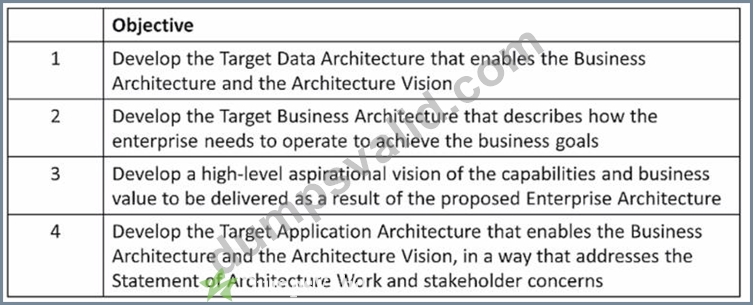
Which phase does each objective match?
- A. 1C-2D-3B-4A
- B. 1B-2D-3A-4C
- C. 1A-2B-3C-4D
- D. 1C-2B-3A-4C
Answer: D
Explanation:
The objectives listed in the question correspond to the objectives of different phases of the TOGAF ADM (Architecture Development Method), which is a method for developing and managing an enterprise architecture1.
The ADM consists of nine phases, each with a specific purpose and output. The phases are1:
Preliminary Phase: To prepare and initiate the architecture development cycle, including defining the architecture framework, principles, and governance.
Phase A: Architecture Vision: To define the scope, vision, and stakeholders of the architecture initiative, and to obtain approval to proceed.
Phase B: Business Architecture: To describe the baseline and target business architecture, and to identify the gaps between them.
Phase C: Information Systems Architectures: To describe the baseline and target data and application architectures, and to identify the gaps between them.
Phase D: Technology Architecture: To describe the baseline and target technology architecture, and to identify the gaps between them.
Phase E: Opportunities and Solutions: To identify and evaluate the opportunities and solutions for implementing the target architecture, and to define the work packages and transition architectures.
Phase F: Migration Planning: To finalize the implementation and migration plan, and to ensure alignment with the enterprise portfolio and project management.
Phase G: Implementation Governance: To provide architecture oversight and guidance for the implementation projects, and to manage any architecture change requests.
Phase H: Architecture Change Management: To monitor the changes in the business and technology environment, and to assess the impact and performance of the architecture.
Based on the above definitions, we can match each objective with the corresponding phase as follows:
Objective 1: Develop the Target Data Architecture that enables the Business Architecture and the Architecture Vision. This objective is achieved in Phase C: Information Systems Architectures, where the data architecture is defined as a subset of the information systems architecture2.
Objective 2: Develop the Target Business Architecture that describes how the enterprise needs to operate to achieve the business goals. This objective is achieved in Phase B: Business Architecture, where the business architecture is defined as a subset of the enterprise architecture3.
Objective 3: Develop a high-level aspirational vision of the capabilities and business value to be delivered as a result of the proposed Enterprise Architecture. This objective is achieved in Phase A: Architecture Vision, where the architecture vision is defined as a high-level description of the target architecture and its benefits4.
Objective 4: Develop the Target Application Architecture that enables the Business Architecture and the Architecture Vision, in a way that addresses the Statement of Architecture Work and stakeholder concerns. This objective is achieved in Phase C: Information Systems Architectures, where the application architecture is defined as a subset of the information systems architecture2.
Reference:
1: The TOGAF Standard, Version 9.2, Chapter 5: Architecture Development Method (ADM)
2: The TOGAF Standard, Version 9.2, Chapter 9: Phase C: Information Systems Architectures
3: The TOGAF Standard, Version 9.2, Chapter 8: Phase B: Business Architecture
4: The TOGAF Standard, Version 9.2, Chapter 7: Phase A: Architecture Vision
NEW QUESTION # 103
What is presented as "striking a balance between positive and negative outcomes resulting from the realization of either opportunities or threats?
- A. Transition Management
- B. Architecture Security
- C. Agile development
- D. Risk Management
Answer: D
Explanation:
Risk Management is the process of identifying, assessing, and responding to risks that may affect the achievement of the enterprise's objectives. Risk Management involves balancing positive and negative outcomes resulting from the realization of either opportunities or threats. Reference: The TOGAF® Standard | The Open Group Website, Section 3.3.3 Risk Management.
NEW QUESTION # 104
Complete the sentence The Enterprise Continuum provides methods for classifying architecture artifacts as they evolve from________________________.
- A. Foundation Architectures to re-usable architecture assets
- B. Solutions Architectures to Solution Building Blocks
- C. generic architectures to reusable Solution Building Blocks
- D. generic architectures to Organization-Specific Architectures
Answer: D
Explanation:
The Enterprise Continuum provides methods for classifying architecture artifacts as they evolve from generic architectures to Organization-Specific Architectures. Generic architectures are architectures that have been developed for use across a wide range of enterprises with similar characteristics. They provide common models, functions, and services that can be reused and adapted for specific purposes. Organization-Specific Architectures are architectures that have been tailored to meet the needs and requirements of a particular enterprise or a major organizational unit within an enterprise. They reflect the unique vision, goals, culture, structure, processes, systems, and technologies of that enterprise or unit. Reference: The TOGAF Standard | The Open Group Website, Section 2.3 Enterprise Continuum.
NEW QUESTION # 105
Full Scenario
You are employed as an Enterprise Architect within the Enterprise Architecture (EA) team at a clinical research and health technologies company. The company has multiple divisions. Your team works within the healthcare division.
The healthcare division is always creating new products and needs to show the effectiveness and safety of the products. This happens in a set of clinical trials that satisfy the legal requirements of the relevant health authorities. The clinical trials are undertaken by the division's research laboratories at multiple facilities worldwide. At any time, there are many clinical trials happening. In addition to internal research and development activities, the healthcare division is also involved in publicly funded research projects with industrial and academic partners.
Your team is working on an architecture project to develop a secure system that will allow the healthcare researchers to share information more easily about their clinical trials. It will make working together easier across the organization. This system will also allow secured collaboration with external partners.
The EA team uses the TOGAF Architecture Development Method with adaptations required to support healthcare production methods and laboratory procedures. Due to the highly sensitive nature of the information that is managed, special care has been taken to ensure that each architecture domain considers the privacy and safety concerns.
The EA team has been instructed to minimize disruptions to the trials and to gradually introduce the new system.
The company has an established EA practice and has adopted the TOGAF standard for use in its architecture work. The EA practice is federated, which allows some interoperability and information sharing between the divisions yet permits partially independent activity. The Vice President of the healthcare division is the sponsor of the Enterprise Architecture activity for your EA team.
Question:
As part of introducing the new system, how would you go about breaking down the project into work packages?
Based on the TOGAF standard which of the following is the best answer?
- A. Use Solution Building Blocks from a Consolidated Gaps, Solutions, and Dependencies Matrix and group into work packages, sequence them, and document rollout using a Transition Architecture State Evolution Table.
- B. Use a Consolidated Gaps, Solutions, and Dependencies Matrix as a planning tool; classify solutions, group similar ones, and regroup into Capability Increments documented in an Architecture Definition Increments Table.
- C. Identify Solution Building Blocks needing development or procurement, eliminate duplicates, group with CRUD matrices, rank work packages, select cost-effective options, and schedule rollouts in Transition Architectures.
- D. Create an Implementation Factor Catalog to indicate actions and constraints. Draw up a matrix with architecture domains and gaps. For each gap, classify solutions as new development, purchased, or existing product. Group similar activities into work packages, identify dependencies, and regroup them into Capability Increments scheduled across Transition Architectures.
Answer: D
Explanation:
In TOGAF, the process of breaking down an initiative into work packages must be grounded in a structured evaluation of gaps, solutions, dependencies, constraints, and implementation factors. Option B precisely follows this guidance. It begins by producing an Implementation Factor Catalog, which is a TOGAF artifact used to record business, technical, regulatory, organizational, and risk considerations that influence implementation. This is especially relevant in the scenario because clinical trials operate under strict regulatory controls, highly sensitive data, and complex coordination across multiple research sites.
Next, Option B calls for creating a gap matrix comparing baseline and target architectures across domains.
For each gap, TOGAF requires classification of solution approaches: new development, purchased solution, or reuse of existing components. This aligns directly with the Solutions Continuum and the practice of forming Solution Building Blocks. Grouping similar activities into work packages is also textbook ADM practice, ensuring traceability from architecture gaps into actionable implementation components.
Furthermore, Option B incorporates dependencies analysis and restructures work packages into Capability Increments, which is the TOGAF-recommended method for incremental delivery and Transition Architectures. This matches the scenario's requirement for gradual rollout to minimize disruption to ongoing clinical trials.
Thus, Option B fully reflects the TOGAF standard for structured work package definition.
NEW QUESTION # 106
Please read this scenario prior to answering the question
You have been appointed as Chief Enterprise Architect (CEA). reporting to the Chief Technical Officer (CTO), of a company established as a separate operating entity by a major automotive manufacturer. The mission of the company is to build a new industry leading unified technology and software platform for electric vehicles.
The company uses the TOGAF Standard as the basis for its Enterprise Architecture (EA) framework, and architecture development follows the purpose-based EA Capability model as described in the TOGAF Series Guide: A Practitioners'Approach to Developing Enterprise Architecture Following the TOGAF ADM.
An end-to-end Target Architecture has been completed with a roadmap for change over a five-year period. The new platform will be a cross-functional effort between hardware and software teams, with significant changes over the old platform. It is expected to be developed in several stages over three years. The EA team has inherited the architecture for the previous generation hardware and software automotive platform, some of which can be carried over to the new unified platform. The EA team has started to define the new platform, including defining which parts of the architecture to carry forward.
Enough of the Business Architecture has been defined, so that work can commence on the Information Systems and Technology Architectures. Those need to be defined to support the core business services that the company plans to provide. The core services will feature an innovative approach with swarm data generated by vehicles, paving the way for autonomous driving in the future.
The presentation and access to different variations of data that the company plans to offer through its platform pose an architecture challenge. The application portfolio and supporting infrastructure need to interact with various existing cloud services and data- Refer to the scenario You have been asked what approach should be taken to determine and organize the work to deliver the requested architectures?
Based on the TOGAF standard which of the following is the best answer?
- A. You will revisit ADM Phase A. identifying the stakeholders and creating a new Architecture Vision.
You will update the Stakeholder map produced for the strategic architecture so it reflects the stakeholders who are now the most relevant to the projects that are to be developed. You would then ask the CTO to make some decisions about the Architecture Roadmap, and update the Implementation and Migration Plan to reflect the decisions. - B. You would refer to the end-to-end Target Architecture for guidance and direction. The first objective should be to identify projects, dependencies and synergies, then prioritize before initiating the projects.
You will develop high-level architecture descriptions. For each project you would estimate effort size, identify reference architectures, and candidate building blocks. You will identify the resource needs considering cost and value. You will document options, risks, and controls to enable viability analysis and trade-off with the stakeholders. - C. You will research leading data businesses, developing high-level Target Data, Application and Technology Architectures. You would review the Architecture Vision in order to estimate the level of detail, time, and breadth of the ADM cycle phases that will be needed to develop the architecture. You will identify and cost major work packages, and then develop an Architecture Roadmap. You would then seek approval by the Architecture Board and initiate the project.
- D. You would look outside the enterprise to research data models and application portfolios of leading big data businesses. You would develop just enough applications, data, and technology architecture to identify options. For each project this should include identification of candidate architecture and solution building blocks. You will identify solution providers, perform a readiness assessment, and assess the viability and fitness of the solution options. You will then document the draft Implementation and Migration plan.
Answer: B
Explanation:
Explanation
The Target Architecture is a description of the future state of the architecture that addresses the business goals and drivers, and satisfies the stakeholder requirements and concerns. The Target Architecture is developed through the Architecture Development Method (ADM), which is the core process of the TOGAF standard that guides the development and management of the enterprise architecture. The Target Architecture is typically divided into four domains: Business, Data, Application, and Technology. The Target Architecture also includes a roadmap for change, which defines the Transition Architectures, the Capability Increments, and the work packages that enable the transition from the Baseline Architecture to the Target Architecture12 The best answer is B, because it describes the approach that should be taken to determine and organize the work to deliver the requested architectures, which are the Information Systems and Technology Architectures.
The answer covers the following steps:
Refer to the end-to-end Target Architecture for guidance and direction. The end-to-end Target Architecture provides the overall vision, scope, and objectives of the architecture work, and the alignment with the business strategy and goals. The end-to-end Target Architecture also provides the high-level definitions and principles for the four architecture domains, and the roadmap for change that outlines the major milestones and deliverables.
Identify projects, dependencies and synergies, then prioritize before initiating the projects. Projects are the units of work that implement the architecture work packages, which are the sets of actions or tasks that are required to implement a specific part of the architecture. Dependencies are the relationships and constraints that affect the order or priority of the projects, such as logical, temporal, or resource dependencies. Synergies are the benefits or advantages that result from the combination or coordination of the projects, such as cost savings, efficiency gains, or innovation opportunities. Prioritization is the process of ranking the projects according to their importance, urgency, or value, and assigning resources and schedules accordingly.
Develop high-level architecture descriptions. High-level architecture descriptions are the outputs of the architecture development phases (B, C, and D) of the ADM cycle, which describe the Business, Data, Application, and Technology Architectures in terms of the Architecture Building Blocks (ABBs) and the Solution Building Blocks (SBBs), which are reusable components of business, IT, or architectural capability. High-level architecture descriptions also include the Architecture Views, which are representations of the system of interest from the perspective of one or more stakeholders and their concerns.
For each project, estimate effort size, identify reference architectures, and candidate building blocks.
Effort size is the measure of the amount of work, time, or resources required to complete a project.
Effort size can be estimated using various techniques, such as analogy, expert judgment, parametric, or bottom-up. Reference architectures are standardized architectures that provide a common framework and vocabulary for a specific domain or industry. Reference architectures can be used as a source of best practices, patterns, and models for the architecture development. Candidate building blocks are the potential ABBs or SBBs that can be used to implement the architecture. Candidate building blocks can be identified from the Architecture Repository, which is a collection of architecture assets, such as models, patterns, principles, standards, and guidelines.
Identify the resource needs considering cost and value. Resource needs are the specifications and criteria that define the acceptable level and quality of the resources required to complete the project, such as human, financial, physical, or technological resources. Resource needs can be identified by analyzing the scope, complexity, and dependencies of the project, and the availability, capability, and suitability of the resources. Cost and value are the factors that influence the allocation and utilization of the resources, such as the budget, the return on investment, the benefits, or the risks.
Document options, risks, and controls to enable viability analysis and trade-off with the stakeholders.
Options are the alternative ways of achieving the project objectives, such as different solutions, technologies, vendors, or approaches. Risks are the effects of uncertainty on the project objectives, such as threats or opportunities. Controls are the measures or actions that are taken to prevent, reduce, or mitigate the risks, such as policies, procedures, or standards. Viability analysis is the process of evaluating and comparing the options, risks, and controls, and determining the feasibility, suitability, and desirability of each option. Trade-off is the decision outcome that balances and reconciles the multiple, often conflicting, requirements and concerns of the stakeholders, and ensures alignment with the Architecture Vision and the Architecture Principles.
References: 1: The TOGAF Standard, Version 9.2, Part II: Architecture Development Method (ADM), Chapter 5: Introduction to the ADM 2: The TOGAF Standard, Version 9.2, Part IV: Architecture Content Framework, Chapter 36: Building Blocks : The TOGAF Standard, Version 9.2, Part II: Architecture Development Method (ADM), Chapter 18: Phase A: Architecture Vision : The TOGAF Standard, Version 9.2, Part II: Architecture Development Method (ADM), Chapter 19: Phase B: Business Architecture : The TOGAF Standard, Version 9.2, Part II: Architecture Development Method (ADM), Chapter 20: Phase C: Information Systems Architectures : The TOGAF Standard, Version 9.2, Part II: Architecture Development Method (ADM), Chapter 21: Phase F: Migration Planning : The TOGAF Standard, Version 9.2, Part III: ADM Guidelines and Techniques, Chapter 23: Architecture Principles : The TOGAF Standard, Version 9.2, Part III:
ADM Guidelines and Techniques, Chapter 30: Trade-Off Analysis : The TOGAF Standard, Version 9.2, Part VI: Architecture Capability Framework, Chapter 46: Tools for Architecture Development : The TOGAF Standard, Version 9.2, Part VI: Architecture Capability Framework, Chapter 47: Architecture Board : The TOGAF Standard, Version 9.2, Part VI: Architecture Capability Framework, Chapter 48: Architecture Compliance : The TOGAF Standard, Version 9.2, Part VI: Architecture Capability Framework, Chapter 49:
Architecture Contract : The TOGAF Standard, Version 9.2, Part VI: Architecture Capability Framework, Chapter 50: Architecture Governance : The TOGAF Standard, Version 9.2, Part VI: Architecture Capability Framework, Chapter 51: Architecture Maturity Models : The TOGAF Standard, Version 9.2, Part VI:
Architecture Capability Framework, Chapter 52: Architecture Skills Framework
NEW QUESTION # 107
You are working as an Enterprise Architect within an Enterprise Architecture (EA) team at a multinational energy company. The company is committed to becoming a net-zero emissions energy business by 2050. To achieve this, the company is focusing on shifting to renewable energy production and adopting eco-friendly practices.
The EA team, which reports to the Chief Technical Officer (CTO), has been tasked with overseeing the transformation to make the company more effective through acquisitions. The company plans to fully integrate these acquisitions, including merging operations and systems.
To address the integration challenges, the EA team leader wants to know how to manage risks and ensure that the company succeeds with the proposed changes. Based on the TOGAF Standard, which of the following is the best answer?
- A. The EA team should develop Business Architecture views that demonstrate how stakeholder concerns are addressed and assess each factor for readiness, urgency, and degree of difficulty.
- B. The EA team should create a Business Scenario to fully describe the business problem that is being addressed by the transformation. Once requirements are identified, they should be evaluated in terms of risks. Any residual risks should be escalated to the Architecture Board.
- C. The EA team should document the risks associated with the transformation in an Implementation Factor Catalog to inform decisions during implementation and deployment.
- D. The EA team should evaluate the company's readiness for change by identifying factors that will impact the transformation. These factors will be used to determine initial risks associated with the initiative.
Answer: B
Explanation:
In TOGAF, creating a Business Scenario is a foundational step in defining and understanding the business problem, especially for complex transformations involving multiple stakeholders and systems, such as in this scenario. This method aligns with Phase A (Architecture Vision) of the TOGAF Architecture Development Method (ADM). Here's why this approach is the most effective:
* Understanding Business Requirements:A Business Scenario provides a structured way to capture and analyze the business requirements, stakeholder concerns, and the contextual elements related to the problem. In this scenario, the company faces challenges in integrating newly acquired companies with existing operations, which includes complex stakeholder concerns across different functional areas.
Developing a Business Scenario allows the EA team to break down these complexities into identifiable and manageable parts.
* Risk Evaluation and Management:By using the Business Scenario approach, the EA team can not only define the requirements but also assess associated risks systematically. TOGAF emphasizes the importance of risk management through identifying potential risks, evaluating their impact, and defining strategies for handling these risks. The process includes assessing how risks can be avoided, transferred, or reduced-a necessary step in large-scale transformations to ensure that risks are proactively managed.
* Residual Risks and Governance:Any risks that cannot be fully resolved should be identified as residual risks and escalated to the Architecture Board, which is aligned with TOGAF's governance approach. The Architecture Board's role in TOGAF is to provide oversight and make critical decisions on risks that exceed the control of the EA team. This ensures that unresolved risks are managed at the appropriate level of the organization.
* Alignment with TOGAF ADM Phases:The Business Scenario approach directly aligns with the Preliminary and Architecture Vision phases of the TOGAF ADM, which focuses on establishing a baseline understanding of the business context and the strategic transformation required. The detailed understanding of requirements, stakeholder concerns, and risks identified here will guide the subsequent phases of the ADM, including Business Architecture and Information Systems Architecture.
* TOGAF Reference (Section 2.6, ADM Techniques):TOGAF provides guidelines on the creation of Business Scenarios as part of ADM Techniques, highlighting the importance of defining a business problem comprehensively to ensure successful transformation. This method includes identification of stakeholders, business requirements, and associated risks, which aligns well with the company's need for strategic and systematic integration of new business units.
By utilizing a Business Scenario, the EA team ensures that all aspects of the transformation are well understood, risks are identified early, and residual risks are managed effectively, aligning with the company's strategic objectives and the TOGAF framework's guidance on risk management and stakeholder alignment.
NEW QUESTION # 108
You are working as an Enterprise Architect within the Enterprise Architecture (EA) team at a healthcare and life sciences company. The EA team is developing a secure system for researchers to share clinical trial information easily across the organization and with external partners.
Due to the highly sensitive nature of the information, each architecture domain must consider privacy and safety concerns. The healthcare division has been directed to minimize disruptions to clinical trials while introducing the new system gradually.
How would you identify the work packages for introducing the new system? Based on the TOGAF standard, which of the following is the best answer?
- A. Use a Consolidated Gaps, Solutions, and Dependencies Matrix to classify each solution, group them into work packages, then regroup into Capability Increments. Document in an Architecture Definition Increments Table.
- B. Identify Solution Building Blocks for development or procurement, then use a CRUD matrix to rank and select the most cost-effective work packages. Schedule the rollout sequentially across regions.
- C. Draw up an Implementation Factor Catalog to indicate actions and constraints. Use a Consolidated Gaps, Solutions, and Dependencies Matrix, then group similar activities into work packages and identify dependencies.
- D. Use a Consolidated Gaps, Solutions, and Dependencies Matrix to create work packages and sequence them into Capability Increments. Document in a Transition Architecture State Evolution Table.
Answer: A
Explanation:
In the TOGAF framework, understanding and addressing stakeholder concerns is crucial, particularly for complex projects with high stakes like the AI-first initiative described in the scenario. This approach aligns well with TOGAF's ADM (Architecture Development Method) and its emphasis on effective stakeholder management and risk assessment. Here's why this is the best course of action:
* Stakeholder Analysis and Documentation:Conducting a stakeholder analysis is foundational in the early stages of any TOGAF project, particularly during the Preliminary and Architecture Vision phases.
This process involves identifying the different stakeholders, understanding their positions, documenting their concerns, and considering any cultural factors that might influence their perspective on the AI-first initiative. Given the diverse concerns raised (such as job security, skill requirements, and cybersecurity), it's essential to have a clear understanding of each stakeholder group's priorities and fears.
* Recording Concerns in the Architecture Vision Document:The Architecture Vision phase in TOGAF focuses on defining the high-level scope and objectives of the architecture project. By documenting stakeholder concerns and the corresponding views in the Architecture Vision document, the EA team ensures that these concerns are transparently acknowledged and addressed as part of the strategic direction. This step not only aligns with TOGAF best practices but also helps in building stakeholder buy-in and trust.
* Architecture Requirements Specification and Risk Management:Risk management is a key aspect of TOGAF's ADM, particularly in the Requirements Management and Implementation Governance phases. Documenting the requirements for addressing specific risks in the Architecture Requirements Specification provides a structured way to ensure that identified risks are acknowledged and managed throughout the transformation. Regular assessments and feedback loops ensure ongoing alignment and adaptability to emerging risks, which is particularly important given the dynamic nature of AI and its associated challenges.
* Alignment with TOGAF ADM Phases:This approach follows the prescribed flow of TOGAF's ADM, starting with stakeholder engagement in the Preliminary and Architecture Vision phases and progressing to risk assessment in the Requirements Management phase. By maintaining a focus on stakeholder needs and formalizing these into architecture requirements, the EA team can ensure that the architecture not only meets business objectives but also mitigates stakeholder concerns.
* TOGAF Reference on Stakeholder Management Techniques:TOGAF places significant emphasis on managing stakeholder concerns through its stakeholder management techniques, which highlight the need to systematically identify, analyze, and address the concerns of all involved parties. This practice helps ensure that the architecture is viable and accepted across the organization.
By conducting a thorough stakeholder analysis and integrating the findings into both the Architecture Vision and the Architecture Requirements Specification, the EA team can proactively address stakeholder concerns, manage risks, and align the AI-first initiative with the agency's strategic objectives. This approach is consistent with TOGAF's guidance and provides a structured framework for addressing both business and technical challenges in the context of an AI-first transformation.
NEW QUESTION # 109
Which statement best describes iteration and the ADM?
- A. The ADM is iterative, over the whole process between phases and within phases
- B. The ADM is iterative within the first cycle and then between phases
- C. The level of detail is defined once and applies to all iterations
- D. The ADM is sequential Iteration is applied within phases
Answer: A
Explanation:
Explanation
This statement best describes iteration and the ADM. The ADM is iterative over the whole process between phases and within phases because it allows for feedback loops and refinements at any point in the architecture development and transition process. Iteration enables architects to address changing requirements, assumptions, constraints, and environments; to validate and improve architectures; to manage risks and issues; and to ensure stakeholder satisfaction and value realization. Reference: The TOGAF Standard | The Open Group Website, Section 3.1 Introduction to the ADM.
NEW QUESTION # 110
What is an objective of the ADM Preliminary Phase?
- A. To create the initial version of the Architecture Roadmap
- B. To obtain approval for the Statement of Architecture Work
- C. To select and implement tools to support the Architecture Capability
- D. To develop a vision of the business value to be delivered by the proposed enterprise architecture
Answer: C
Explanation:
Explanation
The Preliminary Phase is the preparatory phase of the Architecture Development Method (ADM) cycle, which sets the context and direction for the architecture work. One of the objectives of this phase is to select and implement tools to support the Architecture Capability, which is the ability of an organization to perform enterprise architecture effectively and efficiently. Tools can include software applications, methods, techniques, standards, and frameworks that assist the architecture development and governance processes. The selection and implementation of tools should be based on the requirements and constraints of the organization, and the alignment with the Architecture Principles and the Architecture Vision3 References: 3: The TOGAF Standard, Version 9.2, Part II: Architecture Development Method (ADM), Chapter 6: Preliminary Phase : The TOGAF Standard, Version 9.2, Part VI: Architecture Capability Framework, Chapter 45: Establishing and Maintaining an Enterprise Architecture Capability : The TOGAF Standard, Version 9.2, Part VI: Architecture Capability Framework, Chapter 46: Tools for Architecture Development
NEW QUESTION # 111
......
Updated OGEA-103 Dumps Questions For The Open Group Exam: https://www.dumpsvalid.com/OGEA-103-still-valid-exam.html
Best Value Available Preparation Guide for OGEA-103 Exam: https://drive.google.com/open?id=1AMOW0-zisBNI2rTb_ZL6fdNPZrNOrhKt