

Free ISTQB Test Manager Advanced CTAL-TM-001 Ultimate Study Guide (Updated 232 Questions)
Get to the Top with CTAL-TM-001 Practice Exam Questions
NEW QUESTION # 27
You are the Test Manager for a software house (SoftTech), who provide a core banking product to retail banks around the world to enable their customers to process payments via the Internet and telephone banking.
Your current project is to integrate SoftTech's core banking product with Welsh Bank's existing bank systems.
However, Welsh Bank's systems are maintained by experienced developers and are poorly documented.
Welsh Bank has stated that this project must comply with Financial Conduct Authority (FCA) regulatory banking standards.
A specification for the 10 interfaces to Welsh Bank's existing systems has been produced by SoftTech's development team.
You have been asked to plan and conduct reviews for the system integration and support documentation of all the systems. Which of the following is the BEST approach for this project?
SELECT ONE OPTION
- A. Conduct a management review to assess progress of the integration features.
- B. Conduct Inspections to verify that all documentation conforms to a set standard.
- C. Conduct an informal review of the integration documentation before the systems are integrated.
- D. Conduct an audit to verify that all test deliverables have been produced and signed off.
Answer: B
NEW QUESTION # 28
You are a newly appointed Test Manager in an organisation that has no separate test team, no formal testing process and testing is considered to be, at best, ad-hoc in approach. The IT director is keen to introduce improvement across all areas of the organisation, not just testing. This is so that the current level of maturity can be assessed and roadmaps outlined for improving processes in a staged way. He has asked you to recommend a test process improvement model and you have suggested TMMi.
Which ONE of the following is a valid reason for your recommendation? SELECT ONE OPTION
- A. It naturally complements the IT director's process improvement goals for the organisation.
- B. It provides bench-marking against industry averages using objective measurements.
- C. It provides the fastest way to take testing to an optimized state.
- D. It helps address highest priority testing issues with limited formality.
Answer: A
NEW QUESTION # 29
You are the Test Manager of a risk-based testing effort. You develop the following graph to show residual risk. Assume that "Risks mitigated" represents passed tests and "Risks not mitigated" represents failed tests and other discovered failures.
Which of the following answers best represents what the graph shows? [3]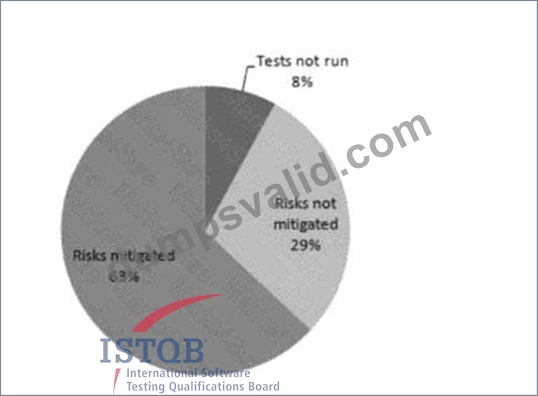
- A. Project is ahead of schedule due to number of risks addressed
- B. Project is on schedule based on total number of test cases executed
- C. Project is behind schedule based on bug fix rate
- D. Project is at risk due to the number of failed tests
Answer: D
Explanation:
The graph indicates that a significant portion of risks, 29%, have not been mitigated, which suggests that these are either failed tests or other discovered failures. This level of unmitigated risk puts the project at risk, as it implies that there are still substantial issues that need to be addressed.
References:The ISTQB Advanced Level Test Manager documents outline the importance of risk-based testing and the interpretation of residual risk graphs. These graphs are used to communicate the current status of risk mitigation efforts in the project, and a high percentage of unmitigated risks is a clear indicator of potential problems1.
NEW QUESTION # 30
Your company just won a contract to create a new sales application and has committed to a very aggressive delivery timeline. Due to the quick turnaround your primary stakeholder wants to be heavily involved in the design and is very anxious to see the outcome. Because of this, your company has decided to use a spiral development approach. You have a defined test policy and typically use an analytical approach to testing, however, this approach will not work with the development approach.
What test strategy should be utilized? [3]
- A. Model-based
- B. Reactive
- C. Standard-compliant
- D. Methodical
Answer: B
Explanation:
A reactive test strategy is a test strategy that uses the actual behavior and results of the software under test to design and execute tests, without prior knowledge or documentation of the software1. A reactive test strategy should be utilized for a project that uses a spiral development approach, which is a type of iterative/incremental approach that adds risk analysis and prototyping activities to each iteration2. A reactive test strategy is suitable for a spiral development approach because it allows for flexibility, adaptability, and creativity in the testing process, as well as for early feedback, risk reduction, and continuous improvement in the software development process3. Therefore, option D is the correct answer. Option A is incorrect because a model-based test strategy is a test strategy that uses models to represent the desired behavior and structure of the software under test, and to derive test cases, test data, test procedures, and test oracles. A model-based test strategy may not work well with a spiral development approach, as it requires the availability and stability of the models, which may not be the case in a spiral development approach that involves frequent changes and refinements of the software under test. Option B is incorrect because a methodical test strategy is a test strategy that uses predefined test methods, techniques, and procedures to design and execute tests, such as equivalence partitioning, boundary value analysis, or decision table testing. A methodical test strategy may not work well with a spiral development approach, as it requires the availability and stability of the test basis, such as the requirements, specifications, or design documents, which may not be the case in a spiral development approach that involves frequent changes and refinements of the software under test. Option C is incorrect because a standard-compliant test strategy is a test strategy that follows a predefined set of standards, guidelines, or regulations to design and execute tests, such as ISO, IEEE, or CMMI. A standard-compliant test strategy may not work well with a spiral development approach, as it requires the compliance and consistency of the testing process, which may not be the case in a spiral development approach that involves frequent changes and refinements of the software under test. Reference: 1: ISTQB Glossary, Reactive Test Strategy 2: ISTQB Glossary, Spiral Model 3: ISTQB Advanced Level Test Manager Syllabus, Section 1.1.1 : Spiral Model in Software Development Life Cycle - Software Testing Material : Spiral Model - Tools QA : Strategic Test Management - ISTQB not-for-profit association : ISTQB Glossary, Model-Based Testing : ISTQB Glossary, Methodical Test Strategy : ISTQB Glossary, Standard-Compliant Test Strategy : ISTQB Foundation Level #39 - Test Approach and Strategy - Software Testing Mentor
NEW QUESTION # 31
While mining the defect database for patterns of problems in the last release, a Test Manager notices that many of the most damaging failures were caused by defects injected during the low-level design phase.
Which of the following actions will likely give this project the most effective solution to this problem? [3]
- A. Increased white-box coverage during system testing
- B. Formal inspections of the code modules affected by the last release
- C. Mandatory reviews of all important design work products
- D. Increased static analysis during the implementation phase
Answer: C
Explanation:
The most effective solution to this problem is to implement mandatory reviews of all important design work products. This is because reviews are a type of static testing technique that can detect and prevent defects early in the software development lifecycle, before they become more costly and difficult to fix. By reviewing the low-level design work products, such as detailed design specifications, the project team can ensure that they are consistent, complete, and correct, and that they meet the requirements and the quality standards. Reviews - ISTQB not-for-profit association References: Certified Tester Advanced Level Test Manager (CTAL-TM) - ISTQB not-for-profit association, ISTQB Test Manager Certification - ISTQB Exams Worldwide - ISTQB Official Registration, Reviews - ISTQB not-for-profit association
NEW QUESTION # 32
You have recently implemented a new defect management process which now includes a defect triage committee whose job is to review all new defects. The process is shown in the following diagram: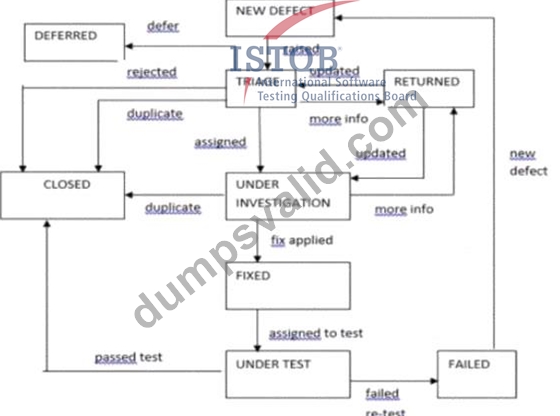
b. The total number of defects rejected as not a problem following investigation by the product author c. The number of defects returned to the defect author, expressed as a percentage of all defects raised d. The total number of defects that failed re-test more than once e. The total number of defects closed by the defect triage committee SELECT ONE OPTION
- A. a and b.
- B. b and d.
- C. a and e.
- D. c and d.
Answer: C
NEW QUESTION # 33
Your company has adopted an Agile methodology. Defect reports are not raised for all bugs found during the testing of individual stories, but continue to be raised in some circumstances, e.g., when the fix cannot be made immediately, or would involve another team. The teams would like better data to use for assessing the quality of their work. The list below shows five items that are currently not captured on defect reports.
Which TWO of these items will be MOST useful for assessing the quality of a product increment?
- A. The level of testing which found the defect
- B. The quality characteristic / sub-characteristic that is affected
- C. The type of the defect from a defect taxonomy
- D. The user story to which the defect relates
- E. The test environment in which the defect was found
Answer: B,D
Explanation:
* B (Quality characteristic): Tells whether the defect affected security, usability, performance, etc.- directly tied to non-functional quality.
* E (User story): Enables tracking of defect-prone functionality and assessment of deliverable quality per increment.
"The information in defect reports supports test process improvement and quality trend analysis. Tracking defects by quality attribute and story link is a valuable input to Agile retrospectives."
-ISTQB CTFL Syllabus 2018, Section 3.2.4 and 5.6
These insights are essential for Agile teams focused on continuous improvement and product quality.
NEW QUESTION # 34
What test process is included as part of TPI Next? [1]
- A. Identify test execution
- B. Identify test specification
- C. Identify test conditions
- D. Identify test environment
Answer: D
Explanation:
According to TPI Next, the test process consists of four main phases: Test Strategy, Test Preparation, Test Execution and Test Completion. Each phase has several key areas thatdescribe the activities and tasks involved in the phase. One of the key areas in the Test Preparation phase is Test Environment, which covers the identification, specification, realization and maintenance of the test environment. The test environment includes the hardware, software, network, data and tools that are required to perform the testing activities. The test environment should be aligned with the test objectives and the system under test, and should be managed throughout the test process. TPI NextTPI Next book References:
* Test Process Improvement (TPI) | TMap
* TPI NEXT | TMap
NEW QUESTION # 35
Which one of the following standards would a Test Manager be expected to understand when planning and organising activities with a Project Manager? SELECT ONE OPTION
- A. CMMI
- B. TMMI
- C. ITIL
- D. PRINCE2
Answer: D
NEW QUESTION # 36
Which of the following statements is true regarding Fault Tree Analysis? [1]
- A. It is used to determine the root cause of observed and potential failures.
- B. It is used to select the pairs of items to be used in pairwise testing.
- C. It is a formal technique used to identify the likely effects of risks.
- D. It is used to target defect-based testing.
Answer: A
Explanation:
Fault Tree Analysis (FTA) is a technique used to analyze the causes of faults (defects). The technique visually models how logical relationships between failures, human errors, and external events can combine to cause specific faults to disclose1. FTA can help to determine the root cause of observed and potential failures by tracing back the fault events to their initiating causes and identifying the combinations of events that can lead to the fault occurrence2. Therefore, option A is the correct answer. Option B is incorrect because FTA is not used to select the pairs of items to be used in pairwise testing, which is a technique to generate test cases based on the combinations of two input parameters. Option C is incorrect because FTA is not a formal technique used to identify the likely effects of risks, which are uncertain events or conditions that may have a positive or negative impact on the project objectives. Option D is incorrect because FTA is not used to target defect-based testing, which is a testing technique that uses information about the types, causes, and locations of defects discovered in previous projects to guide the selection, creation, and prioritization of test cases. References: 1: Fault Tree Analysis | ISTQB Glossary 2: Fault Tree Analysis (FTA) - Software Testing Genius : ISTQB Glossary, Pairwise Testing : ISTQB Glossary, Risk : ISTQB Glossary, Defect-Based Test Technique : Fault Tree Analysis (FTA) - Software Testing Genius : Fault Tree Analysis | ISTQB Glossary
NEW QUESTION # 37
Your organisation, a high-street bank, is to embark on a project that delivers a major update to the design of its website and also involves functional and performance improvementchanges to its backend core banking engine. It has traditionally used the V-model software development lifecycle to deliver its projects but has now decided to start migrating to Agile (SCRUM). However, after considering the organisation's current processes and skills plus the importance of the project, senior management has decided to continue to use the V-model approach for the backend core banking engine changes. For the same reasons, they have decided to implement a hybrid model for the website updates. The website updates will begin with a traditional requirement definition phase and will then transition to an Agile (SCRUM) approach for development and testing. The organisation's test policy mandates that all tests must be fully traceable to business requirements to satisfy the regular audits that take place in the banking sector. Which TWO test management activities would be MOST appropriate for the new project?
- A. Plan exploratory testing on all of the new website features but use formal scripting for the banking engine
- B. Ensure there is a continual review of test progress with regular test monitoring and reporting across the whole project
- C. Select tools for test automation and continuous integration for the website changes
- D. Ask the business to identify and analyse all product risks, then ensure testing contributes to risk mitigation strategies
- E. Avoid distinct test phases and ensure testing is continuous and integrated across the whole project
Answer: B,D
Explanation:
This hybrid approach necessitatesrisk-based test planningandcontinuous monitoring, especially with traceability required for audits.
"One of the key responsibilities of the Test Manager is to ensure test activities support risk mitigation and ensure regular monitoring aligned to regulatory compliance." (Source: ISTQB Advanced Level Test Manager Syllabus 2012, Sections 1.5, 2.3.1 and 5.2) Thus,A and Cbest align with the test management goals for this hybrid project.
NEW QUESTION # 38
You are a Test Manager on a new project. The software that is being created will be used to control the projectors in movie theaters. This is a time critical project because the software must be released before the Christmas holiday season which has the highest movie attendance of the year.
You have decided to implement a review process for the work products that are a part of this release to save both time and money. In order to expedite the training, you brought in a consultant to train the participants and moderators in proper review processes. Your team is enthusiastic about participating in the reviews.
Your manager is questioning the money you have spent on this training effort. He wants to know how you intend to justify the expense when you present your numbers at the annual budget meeting in February.
What would be a reasonable way for you to justify the cost of the training and the reviews when you present your information at the budget meeting? [3]
- A. Compare the production defects from the previous project to the production defects from this project and explain the cost benefits due to the defect reduction in production.
- B. Show the defects that were found in the review sessions and show the cost of quality regarding the perfect phase containment for those caught defects.
- C. Explain that the reviews are a way of expanding the knowledge of your people and will motivate them to work harder and faster, thus saving money for the company.
- D. Calculate the ROI using the difference between the cost of the reviews and the cost of dealing with defect escapes.
Answer: D
Explanation:
The cost of the training and the reviews can be justified by showing the return on investment (ROI) that they generate. ROI is a measure of the profitability of an investment, calculated by dividing the net benefit by the cost1. The net benefit of the training and the reviews is the difference between the cost of the reviews and the cost of dealing with defect escapes. Defect escapes are defects that are not detected during the review process and are found later in the development or testing phases, or even in production. The cost of dealing with defect escapes includes the cost of rework, testing, debugging, deployment, customer support, and potential loss of reputation or revenue2. The cost of the reviews includes the cost of the training, the time spent by the reviewers and moderators, the tools and resources used, and the overheads3. By calculating the ROI, you can demonstrate how much money the training and the reviews have saved or earned for the company, compared to the alternative of not conducting them. Therefore, option D is the correct answer. Option A is incorrect because comparing the production defects from the previous project to the production defects from this project does not account for the cost of the reviews or the cost of dealing with defect escapes in other phases.
Option B is incorrect because showing the defects that were found in the review sessions and the cost of quality regarding the perfect phase containment for those caught defects does not account for the cost of the training or the cost of dealing with defect escapes in production. Option C is incorrect because explaining that the reviews are a way of expanding the knowledge of your people and motivating them to work harder and faster is not a quantifiable or verifiable way of justifying the cost of the training and the reviews. References: 1: ISTQB Glossary, Return on Investment 2: ISTQB Advanced Level Test Manager Syllabus, Section 2.3.2 3: How to manage formal reviews & management audits? Skills, metrics ...
NEW QUESTION # 39
Which of the following is a valid drawback of independent testing? 1 credit
- A. Developer and independent testing will overlap and waste resources.
- B. Developers loose the sense of responsibility and independent testers may become a bottleneck.
- C. Independent testers will become a bottleneck and introduce problems in incident management.
- D. Independent testers need extra education and always cost more.
Answer: B
NEW QUESTION # 40
Which of the Mowing should be used to understand the context of testing within an organization?
- A. The organizational test strategy
- B. The budget
- C. The schedule
- D. Stakeholder organization chart
Answer: A
Explanation:
Context Analysis:
The test strategy defines th Context Analysis:
Monitoring code coverage is inherently tied to knowledge of the internal structure of the software, a characteristic of white-box testing.
Evaluation of Options:
A . Black-box:
Incorrect. Black-box testing focuses on functionality without knowledge of internal structures.
B . White-box:
Correct. White-box testing uses internal code knowledge to determine areas that need more coverage.
C . Functional:
Incorrect. Functional testing assesses functionality without inspecting internal code.
D . Non-functional:
Incorrect. Non-functional testing focuses on performance, usability, etc., not code coverage.
Syllabus Alignment:
ISTQB associates code coverage monitoring with white-box testing techniques (TM-1.2.6).
Reference:
ISTQB Advanced Level Test Management Syllabus (TM-1.2.6)
approach, resources, and processes for testing within an organization. It provides insight into the testing context.
Evaluation of Options:
A . The organizational test strategy:
Correct. It offers a comprehensive understanding of the organization's testing framework.
B . Stakeholder organization chart:
Incorrect. Useful for identifying roles but does not provide a testing context.
C . The schedule:
Incorrect. Reflects timelines but not testing approaches or resources.
D . The budget:
Incorrect. Indicates financial constraints but not the testing context.
Syllabus Alignment:
ISTQB emphasizes using the organizational test strategy to understand the testing context (TM-1.4.1).
ISTQB Advanced Level Test Management Syllabus (TM-1.4.1)
NEW QUESTION # 41
Refer to SCENARIO 2 Project 2 is to be delivered using a RAD software development model. There will be two increments, the first will deliver a simple prototype user interface to facilitate testing of the sound system delivered by 'Silver Sound Ltd', the second will deliver the full user interface required for the production system.
Development of the business requirements and project plan are underway, detailed system analysis will follow for each increment.
You have studied the test policy and risk register and must plan the next set of test activities. Which one of the following is the MOST effective approach for this project?
SELECT ONE OPTION
- A. Finalize detailed test planning now for both increments, conduct exploratory testing for the first increment, then use automated tests only for increment 2.
- B. Conduct exploratory testing only for the first increment as it is a prototype solution, commence test charter planning for increment 2
- C. Conduct high-level test planning and test analysis now, followed by more detailed test planning and test analysis for each increment considering use of automation where appropriate.
- D. Develop a master lest plan for each increment as soon as systems analysis is complete, then proceed with test analysis.
Answer: C
NEW QUESTION # 42
As part of the improvement program, the organization is also looking at tool support. Which type of tool could be used to ensure higher quality of the code to be reviewed? 1 credit
- A. Test execution tool
- B. Test design tool
- C. Static analysis tool
- D. Review tool
Answer: C
Explanation:
Explanation/Reference:
Explanation:
NEW QUESTION # 43
Which of the following are primary activities in conducting product risk analysis?
- A. Risk testing, risk management
- B. Risk management, risk assessment
- C. Risk identification, risk testing
- D. Risk identification, risk assessment
Answer: D
Explanation:
Product risk analysis is the process of identifying and assessing the product risks that may affect the quality or functionality of the software under test1. Product risk analysis involves two primary activities: risk identification and risk assessment. Risk identificationis the activity of finding, naming, and describing the risks that might affect the software under test2. Risk assessment is the activity of estimating the impact and probability of occurrence (likelihood) of the identified risks, and prioritizing them based on these factors3.
Therefore, option B is the correct answer. Option A is incorrect because risk testing and risk management are not primary activities of product risk analysis, but rather activities that follow or use the results of product risk analysis. Risk testing is the activity of designing, implementing, and executing tests based on the product risk levels to reduce the level of product risks and inform stakeholders of their status4. Risk management is the activity of planning, monitoring, and controlling the risks and the risk mitigation actions in the software project5. Option C is incorrect because risk identification and risk testing are not primary activities of product risk analysis, but rather activities that are part of product risk analysis and risk-based testing respectively. Option D is incorrect because risk management and risk assessment are not primary activities of product risk analysis, but rather activities that are part of risk management and product risk analysis respectively. References: 1: ISTQB Glossary, Product Risk Analysis 2: ISTQB Glossary, Risk Identification 3: ISTQB Glossary, Risk Assessment 4: ISTQB Glossary, Risk-Based Testing 5: ISTQB Glossary, Risk Management : Product Risk Analysis (PRA) | TMap : Risk-Based Testing | ISTQB Glossary : Risk Analysis | ISTQB Glossary
NEW QUESTION # 44
Which work experience is likely to develop the necessary skills to effectively test a software system?
- A. Being a former Test Manager
- B. Being the developer of testing tools used for automation
- C. Being a member of the production group that supported the previous release of the system
- D. Being the current Project Manager for the system
Answer: B
Explanation:
Being the developer of testing tools used for automation is likely to develop the necessary skills to effectively test a software system because it involves a deep understanding of testing processes and the creation of tools that facilitate these processes. This experience provides insight into the intricacies of test automation, which is crucial for designing effective tests and ensuring thorough coverage of the system under test.
References: The current page suggests referring to the ISTQB Advanced Level Test Manager Syllabus and other ISTQB documents for a comprehensive understanding of the roles and skills required for effective software testing. It emphasizes the importance of alignment of methodologies in distributed testing models, which is relevant to the development and use of testing tools.
NEW QUESTION # 45
Consider the typical objectives of testing. Which of the following metrics can be used to measure the effectiveness of the testing process in achieving one of those objectives? 1 credit
- A. Percentage of test effort spent on regression testing
- B. Lines of code written per developer per day
- C. Percentage of requirements covered
- D. Average number of days between defect discovery and resolution
Answer: C
NEW QUESTION # 46
Evaluate the status of the project against the defined exit criteria. Which of the following options shows the correct status? 2 credits
- A. Criteria A = OK, criteria B = OK, criteria C = OK
- B. Criteria A = OK, criteria B = NOT OK, criteria C = NOT OK
- C. Criteria A = NOT OK, criteria B = NOT OK, criteria C = OK
- D. Criteria A = NOT OK, criteria B = NOT OK, criteria C = NOT OK
Answer: C
Explanation:
Explanation/Reference:
Explanation:
NEW QUESTION # 47
The diagram shows a defect workflow in which two states do not have appropriate names.
Which option could correctly provide the missing state names?
- A. State X = Open, State Y = Clarification
- B. State X = Confirmation, State Y = Resolved
- C. State X = Duplicate, State Y = Postponed
- D. State X = Terminated, State Y = Archived
Answer: A
Explanation:
In a standard defect lifecycle, typical early states include:
* Open: when the defect has been logged and confirmed.
* Clarification: when more information is needed before further action can be taken.
According to the ISTQB CTFL Syllabus:
"Defects typically go through a life cycle: new, open, assigned, fixed, retested, closed. Variants like 'in clarification' or 'duplicate' may be used depending on the organization's workflow."
-ISTQB CTFL Syllabus 2018, Section 5.6
These terms fit the typical transitions in a defect lifecycle, makingOption Athe correct match.
NEW QUESTION # 48
You are managing a project that will be using a model-based testing strategy.
Which of the following is an activity that will be needed in order to implement this strategy? [1]
- A. Select an appropriate quality standard, such as ISO 9126, to be used to guide the testing.
- B. Conduct a quality risk analysis with all affected stakeholders.
- C. Create the test charters for the exploratory testing sessions.
- D. Conduct operational profiling to determine the expected usage of the system.
Answer: A
Explanation:
A model-based testing strategy is a testing strategy that uses models to represent the desired behavior and structure of the system under test, and to derive test cases, test data, test procedures, and test oracles1. A model-based testing strategy requires an activity to select an appropriate quality standard, such as ISO 9126, to be used to guide the testing. A quality standard is a set of criteria, guidelines, or characteristics that define the quality attributes of a software product, such as functionality, reliability, usability, efficiency, maintainability, and portability2. A quality standard can help to define the quality requirements, objectives, and measures for the system under test, and to evaluate the quality of the test results and the test process3. Therefore, option C is the correct answer. Option A is incorrect because conducting a quality risk analysis with all affected stakeholders is not an activity specific to a model-based testing strategy, but rather a general testing activity that can be applied to any testing strategy. A quality risk analysis is a process of identifying and assessing the quality risks that may affect the system under test, and prioritizing them based on their impact and likelihood4. Option B is incorrect because conducting operational profiling to determine the expected usage of the system is not an activity specific to a model-based testing strategy, but rather an activity related to a usage-based testing strategy. An operational profile is a statistical representation of the relative frequencies of the inputs, operations, and operating conditions of a system in its operational environment. Option D is incorrect because creating the test charters for the exploratory testing sessions is not an activity specific to a model-based testing strategy, but rather an activity related to an exploratory testing strategy. A test charter is a document that defines the scope, objective, and approach of an exploratory testing session. Reference: 1: ISTQB Glossary, Model-Based Testing 2: ISTQB Glossary, Quality Standard 3: ISTQB Advanced Level Test Manager Syllabus, Section 1.3.1 4: ISTQB Glossary, Quality Risk Analysis : ISTQB Glossary, Operational Profile : ISTQB Glossary, Test Charter : Model-Based Tester - ISTQB not-for-profit association : ISTQB Model-Based Testing Certification - ISTQB Exams Worldwide - ISTQB ... : ISTQB - ABOUT MODEL-BASED TESTER EXT. : ISTQB Certified Tester - Model-Based Tester (CT-MBT)
NEW QUESTION # 49
Your test team has created a custom automation tool that will be used for an upcoming release. Now that the tool has been coded, what should be the next step? [1]
- A. Create the tool support guide
- B. Perform an ROI study
- C. Test the tool
- D. Compare the new tool to open source tools
Answer: C
Explanation:
The next step after creating a custom automation tool is to test the tool itself. This is to ensure that the tool is reliable, functional, and compatible with the system under test. Testing the tool involves verifying its features, performance, usability, security, and stability. Testing the tool also helps to identify and fix any defects or issues before using it for the actual testing of the product. ISTQB Advanced Level Test Manager SyllabusTop 7 Automation Testing Tools to Consider Reference:
ISTQB Advanced Level Test Manager Syllabus
Top 7 Automation Testing Tools to Consider - testRigor AI-Based ...
NEW QUESTION # 50
......
Pass ISTQB CTAL-TM-001 exam - questions - convert Tets Engine to PDF: https://www.dumpsvalid.com/CTAL-TM-001-still-valid-exam.html
Use Real CTAL-TM-001 Dumps Free Sample Questions and Practice Test Engine: https://drive.google.com/open?id=1AF5V-YVfA0MOdVr0SpxWz0zwvP7jY3l8