

[Feb 07, 2026] Ultimate 1Z1-591 Guide to Prepare Free Latest Oracle Practice Tests Dumps
Get Top-Rated Oracle 1Z1-591 Exam Dumps Now
NEW QUESTION # 46
Which OBIEE capability enables developers to build Aggregate tables?
- A. Aggregate Persistence Wizard
- B. Expression Builder
- C. Table Builder
- D. Query Analyzer
Answer: A
Explanation:
Explanation/Reference:
Aggregate Persistence Wizard automates the creation and initial population of aggregates, persists them in a back-end database and configures the BI Server metadata layer so that they're used when appropriate.
NEW QUESTION # 47
If a customer is planning on building a data warehouse, how would you describe data warehousing to the customer?
- A. Data warehouse projects are usually implemented within two weeks.
- B. Application based data warehouses can be bought off the shelf and used without any tweaking.
- C. Data warehouses can only be based on multidimensional data modeling.
- D. The data in the data warehouse describes events and statuses of business processes, products and services, goals and organizational units, and generally mirrors every aspect of the structure and behavior of the organization.
Answer: D
Explanation:
Explanation
A data warehouse is a database used for reporting and data analysis. It is a central repository of data which is created by integrating data from multiple disparate sources. Data warehouses store current as well as historical data and are commonly used for creating trending reports for senior management reporting such as annual and quarterly comparisons.
NEW QUESTION # 48
Identify the reason why Oracle OLAP provides a favorable aggregation strategy.
- A. OLAP cubes can be queried by using SQL.
- B. OLAP cubes can be easily transported from database to database.
- C. OLAP cubes eliminate the need for a large number of aggregate tables.
- D. OLAP cubes are stored outside of the database in highly optimized file structures.
Answer: A
Explanation:
All metadata for cubes and dimensions is stored in the Oracle database and revealed in the data dictionary views, so that you can query the entire business model in SQL.
Reference: Oracle OLAP User's Guide, What's New in Oracle OLAP?
NEW QUESTION # 49
How do you get the BI plug-in for MS Office?
- A. By downloading it from the Database Server
- B. By downloading it from Microsoft Server
- C. By contacting the administrator
- D. By downloading it from the BI Server
Answer: D
Explanation:
Download and installation of the client
The client install executable is available for download from the More Products menu in Oracle BI Interactive Dashboards and Oracle BI Answers.
See picture below.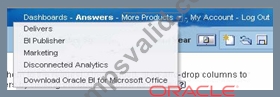
NEW QUESTION # 50
Which are the three types of tables available to physical tables in the physical layer?
- A. View
- B. Physical Table
- C. Stored Proc
- D. Table
- E. Select
Answer: B,C,E
Explanation:
Explanation/Reference:
Pull the table and column definition into the physical layer
Use the OBIEE "import metadata" wizard to pull the table and column definition into the physical layer. The wizard is used so that all of the column definitions do not need to be manually added into the physical layer.
Figure: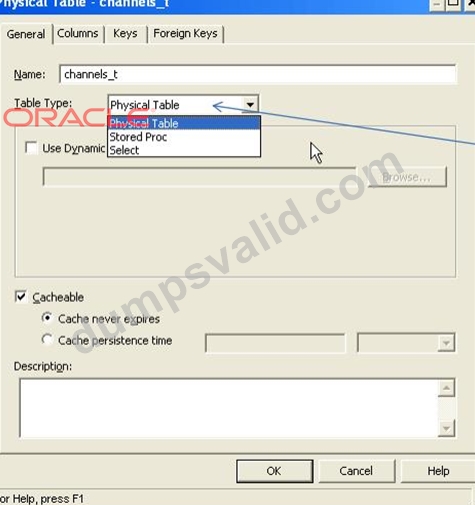
Note: The physical layer is the layer of the Logical Business Model where you define the physical data model of your data source. It contains information about the physical data sources.
NEW QUESTION # 51
Which configuration can be changed through Enterprise Manager?
- A. Manages user login
- B. Start and Stop BI Services
- C. Minimum Number of Rows to Download to Excel
- D. The default BI Server Repository
Answer: D
Explanation:
The Repository can be configured within the Enterprise Manager. See Note 1 below.
Note 1:Once you've locked the Oracle BI Domain, you would then use the same screen back in
Enterprise Manager to browse and select the RPD file, and then enter the password, twice.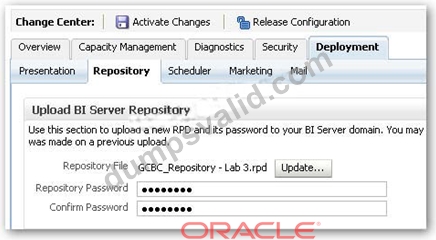
NewImage Once you've entered these details you would then press the Apply button, to save the changes. At this point, the RPD gets a sequence number after it, and it's displayed as the current default online repository for the Oracle BI Domain.
Note2: An OBIEE 11g system (or "Oracle BI Domain") is generally managed through a combination of Oracle Enterprise Manager Fusion Middleware Control, part of the Enterprise Manager "family", or through WebLogic Server Scripting Tool (WLST) scripts. Each Fusion Middleware Control instance as shipped with OBIEE 11g controls a single Oracle BI Domain (DEV, or PROD for example), and is installed along with WebLogic Server Admin Console in the WebLogic Admin Server, one of the two JVMs (the other being the managed server) that gets installed by default with OBIEE 11g. The screenshot below shows Fusion Middleware Control showing the status of the BI Server, Presentation Server and other system components within the installation.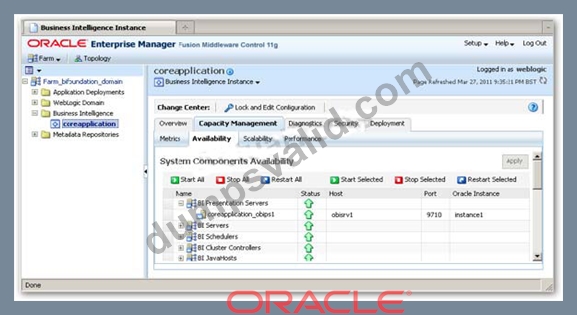
Sshot 2
NEW QUESTION # 52
Select the correct statement.
- A. Cache can increase traffic to back end database.
- B. Cache is seeded by manually running PL/SQL at the back end database.
- C. Cache provides fast and always up-to-date information.
- D. Cachecan degrade query performance by reading data from the disk instead of the database.
- E. Cache needs to be purged to refresh data.
Answer: E
Explanation:
In a standard OBIEE implementation, we generally want to purge and re-build the cache after every ETL (extract, transform, and load) run.
NEW QUESTION # 53
OBIEE default security model stores security Information such as user names and password combinations for accessing an external system such as Active Directory. It is stored in the____________.
- A. Policy Store
- B. Person Store
- C. Identity Store
- D. Credential Store
Answer: C
Explanation:
Identity Store: It is directory server to perform the authentication. It contains user name , password and groups membership information .When a user name and password combination is entered at log in, the authentication provider searches the identity store to verify the credentials provided. See figure below.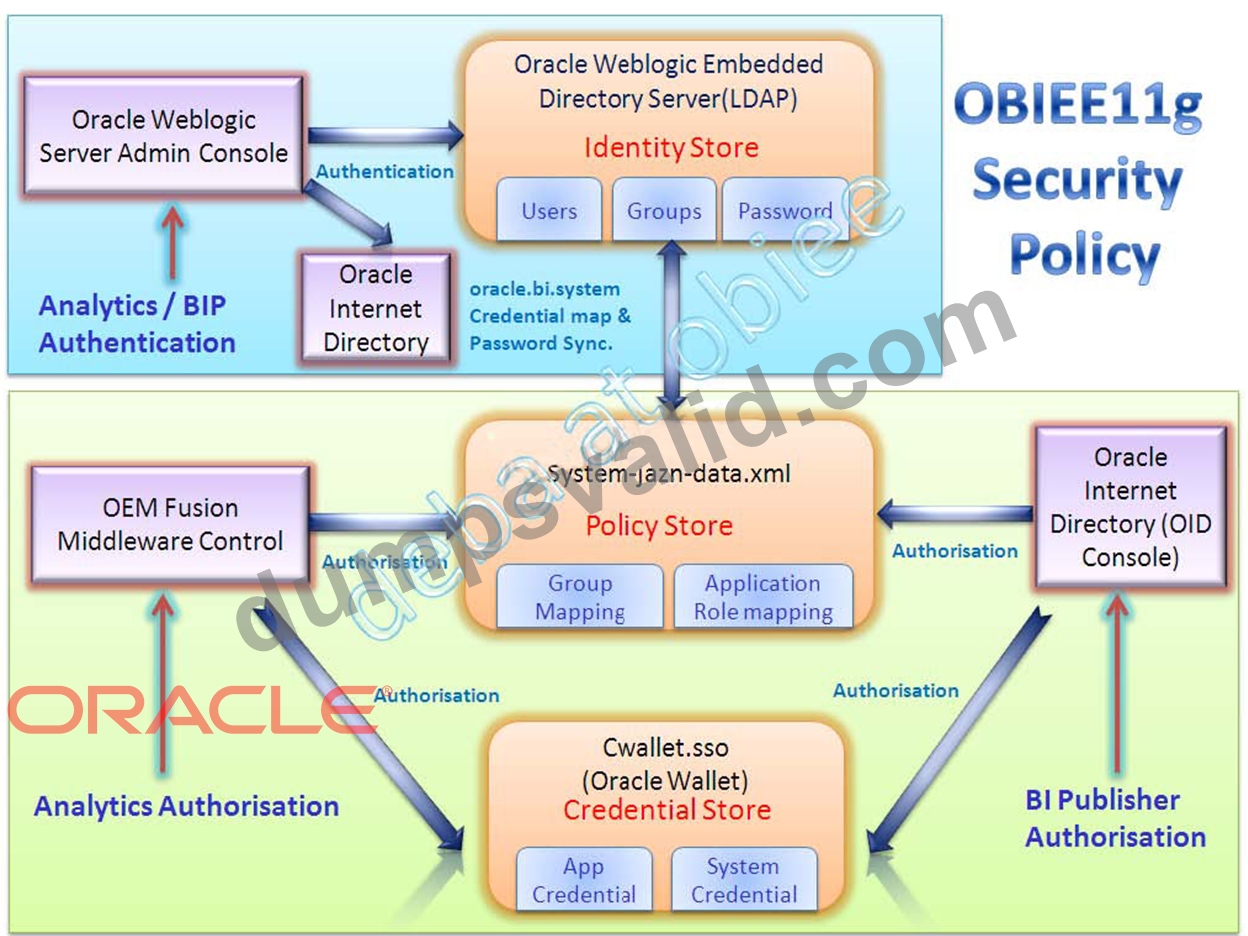
http://debaatobiee.files.wordpress.com/2011/02/obiee-11g-security-policy-revised1.png
NEW QUESTION # 54
A customer needs to have a calculation done prior to aggregating the data. How would you accomplish this?
- A. By creating a derived measure by using the Logical Columns available
- B. By creating a derived metricby using the Expression Builder
- C. By creating a derived measure in the Column Mapping dialog box byusing the physical tablecolumns.
- D. By creatinga derived metricby using the Calculation Wizard
- E. By creating a derived measure by using LogicColumnsavailable andchanging theaggregationtype
Answer: E
Explanation:
Note1: OBIEE offers two calculation types for measure in the repository:
logical
physical
You can define calculations in either of the following ways:
*Before the aggregation, in the logical table source.
*After the aggregation, in a logical column derived from two other logical columns. For example: sum(col A) * sum(col B)
Note 2:A measure column is a column unlike the baseline column that has a default aggregation
rule defined in the Aggregation tab of the Logical Column dialog in the repository.
Measure columns always calculate the aggregation with which they are defined.
Measures need to be defined in a logical fact. Any column with an aggregation rule is a measure.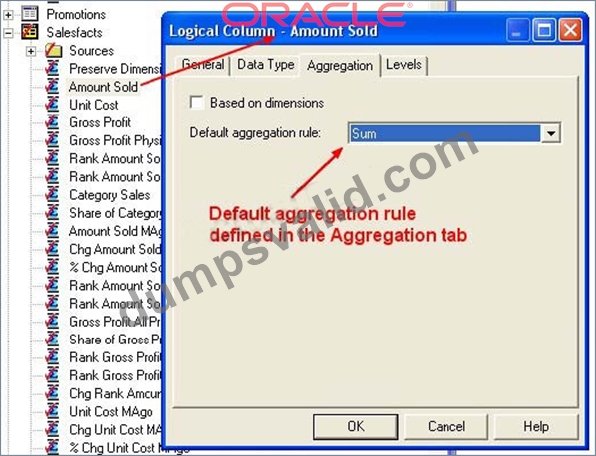
http://gerardnico.com/wiki/_media/dat/obiee/bi_server/design/obiee_measure_column.jpg
NEW QUESTION # 55
WLS Embedded LDAP Server is managed by the Admin Server Console and supports which three options?
- A. Creating and Maintaining Users
- B. Subject area and row-level security, connection pool passwords
- C. Basic Directory for storing user details
- D. Application of Session Variables as Data Filters
- E. Authentication and Authorization
Answer: A,B,C
Explanation:
Explanation/Reference:
WLS Embedded LDAP Server
*By default, OBIEE 11g users and groups are now held in the WLS LDAP Server (C)
- More robust directory for storing user details
- Recommended for >1000 users
* WLS Admin Server Console now used for
creating and maintaining users (A)
* BI Server "outsources" all authentication,
authorization to FMW11g (not B)
* BI Administration tool now used for
subject area and row-level security,
connection pool passwords only (D)
* WLS LDAP Server can be "swapped out"
for alternative directories (MS AD etc)
NEW QUESTION # 56
A user's BI Home page provides one-click access to which three options?
- A. Catalog search functionality
- B. Business model metadata
- C. Create new content
- D. Dashboard layout editor
- E. Oracle BI online documentation
Answer: A,C,E
Explanation:
See BI Home Page screenshot below: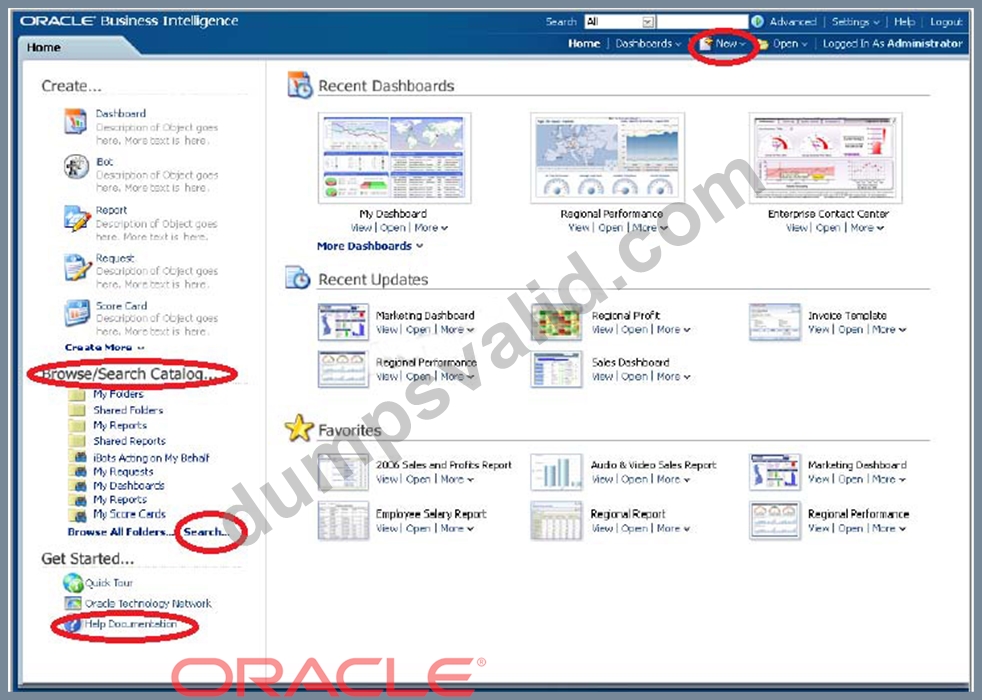
Note:The BI Home page contains the BI content catalog. Fusion Apps will use OBIEE web catalog to store all shipped reporting and analytics content. From the BI home page users can browse and view the entire BI content. The BI catalog folder structure will match the Fusion Apps main menu structure. Folder structure would be content driven not technology driven which would enable ease of navigation for fusion Apps users.
Following content will be available under the BI catalog structure: BI Publisher Reports (regardless of data source) OTBI reports & dashboards OBIA dashboards & scorecards Financial Reporting
Also, users can do some additional actions from the BI Home page like: Access personal and shared reports, View/ edit BI publisher report schedules, Launch BI tools for advanced actions and create new reports with report wizard.
New reports created can be saved in BI catalog and added as embedded content within Fusion applications screens or links added to reporting pane. This enables users to extend the prebuilt embedded analytics within Fusion Applications.
NEW QUESTION # 57
Identify the two Object level security functions that are done on the repository by using the BI Admin tool.
- A. Create a new user in the repository
- B. Define permissions for Dashboard
- C. Assign users to a web catalog group
- D. Create a new repository group
- E. Create a web catalog group
Answer: A,D
Explanation:
Explanation
The Oracle Business Intelligence (BI) Administration Tool can be used to build, modify, enhance, and manage an Oracle BI repository.
C: To add a new user to a repository
1 Open a repository in the Administration Tool.
2 Display the security manager by selecting Manage > Security.
3 Select Action > New > User to open the User dialog box.
4 Type a name and password for the user.
5 If you want to log queries for this user in the query log, change the query logging level to 1 or 2.
6 Click OK.
This creates a new user with default rights granted to it.
Note: What is Oracle BI Admin Tool/Oracle Business Intelligence Administration Tool?
Oracle Business Intelligence Administration Tool is Used to manage OBIEE server Available only for Windows operating systems.
A Windows application that allows the BI Server administrator to create & edit repositories.
Can edit repositories in either online or offline mode.
Having a session manager and a cache manager in online mode.
NEW QUESTION # 58
Which are the three types of tables available to physical tables in the physical layer?
- A. View
- B. Physical Table
- C. Stored Proc
- D. Table
- E. Select
Answer: B,C,E
Explanation:
Pull the table and column definition into the physical layer
Use the OBIEE "import metadata" wizard to pull the table and column definition into the physical layer. The wizard is used so that all of the column definitions do not need to be manually added into the physical layer.
Figure: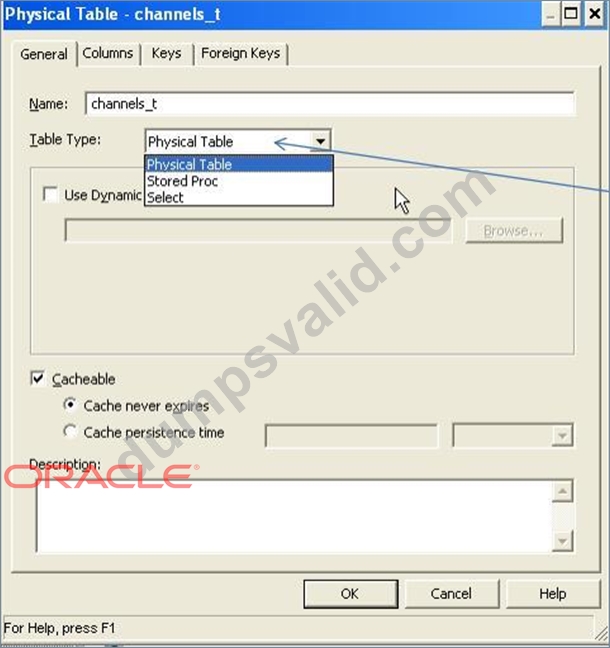
Note: The physical layer is the layer of the Logical Business Model where you define the physical data model of your data source. It contains information about the physical data sources.
NEW QUESTION # 59
When designing a Star Schema, which option does not apply?
- A. The fact has several foreign keys that are primary keys in the dimensional table
- B. Fact table is joined to the related dimensional tables.
- C. The facts are quantifiable.
- D. Dimensional tables have one attribute primary key as Product_ID for products.
- E. Dimensional tables are normalized.
Answer: E
Explanation:
Explanation/Reference:
In a Star Schema the dimensional tables does not need to be normalized.
A Snowflake Schema is a modified Star Schema that has normalized the dimensional tables.
Incorrect answers:
B: A star schema is a dimensional schema with a single fact table that has foreign key relationships with several dimension tables.
C, E: A star join is a primary key to foreign key join :
* of the dimension tables
* to a fact_table.
See picture below: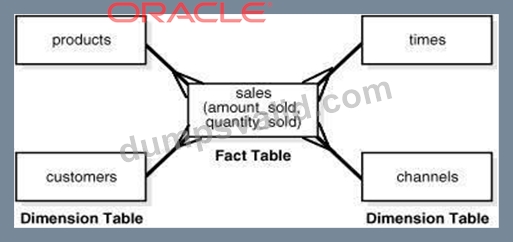
NEW QUESTION # 60
Oracle BI Server cache setup information is configured by using Enterprise Manager Fusion Middleware control. Which component stores the configuration Information?
- A. Cache table in OBIEE repository
- B. Instanceconfig.xml
- C. Web Catalogue
- D. NQSConfig.ini
Answer: D
Explanation:
Explanation
Explanation/Reference:
NQSConfig.ini is the main configuration file of Bi Server and contains a lot of parameters.
The parameters in the Query Result Cache Section provide configuration information for Oracle BI Server caching. The query cache is enabled by default. After deciding on a strategy for flushing outdated entries, you should configure the cache storage parameters in Fusion Middleware Control and in the NQSConfig.INI file.
Incorrect answers:
D: On 10g, Instanceconfig.xml is THE parameter file of the BI Presentation server. With the advent of 11g, instanceconfig.xml is also the configuration file of Oracle BI Scheduler The instanceconfig.xml file stores the configuration settings that affect Oracle BI Presentation Services.
NEW QUESTION # 61
An integrated BI tools business case can be built around which three options?
- A. Fault tolerance
- B. Scalability
- C. Cost Savings
- D. Development efficiency
Answer: B,C,D
NEW QUESTION # 62
What is the process in which there is redundancy of data to improve performance?
- A. Redundancy
- B. Denormalization
- C. Cardinality
- D. Normalization
- E. Granularity
Answer: B
Explanation:
Denormalization is the process of intentionally backing away from normalization to improve performance by suppressing join and permitting the use of star transformation technique.
Denormalization should not be the first choice for improving performance and should only be used for fine tuning of a database for a particular application.
NEW QUESTION # 63
A derived measure is never used to_________.
- A. Calculate share measures
- B. Input data
- C. Calculate a variance between two measures
- D. Add two logical columns together
- E. Calculate the rank dimension values
Answer: B
NEW QUESTION # 64
Query limits tab can be accessed through________.
- A. Security Manager, Application Roles tab, Query dialog box, Permissions
- B. Security Manager, Application Roles tab, Application role dialog box, Permissions
- C. Security Manager, Query tab, Application role dialog box, Permissions
- D. Security Manager, Application Roles tab, Application role dialog box, Query Properties
Answer: B
Explanation:
Query environment can be managed by setting query limits (governors) in the Repository (RPD) for particular Application Roles. You should always set query limits for particular application roles rather than for individual users. Steps:
1.Login to Repository using OBIEE Admin Tool
2.Navigate to Manage > Identity
3.Go to Application Role tab, choose the role and double click on it to open.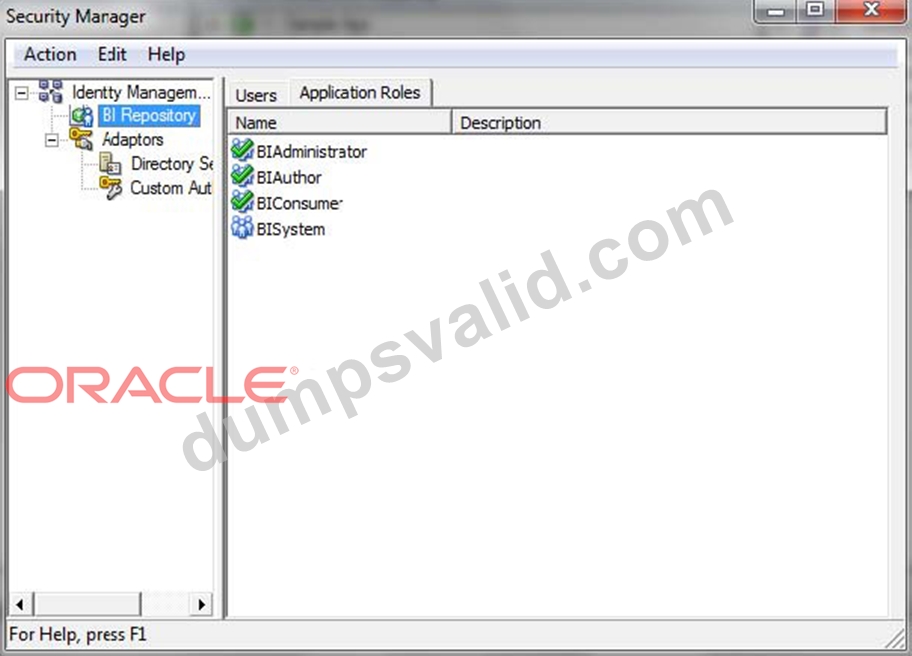
4. Click on Permissions tab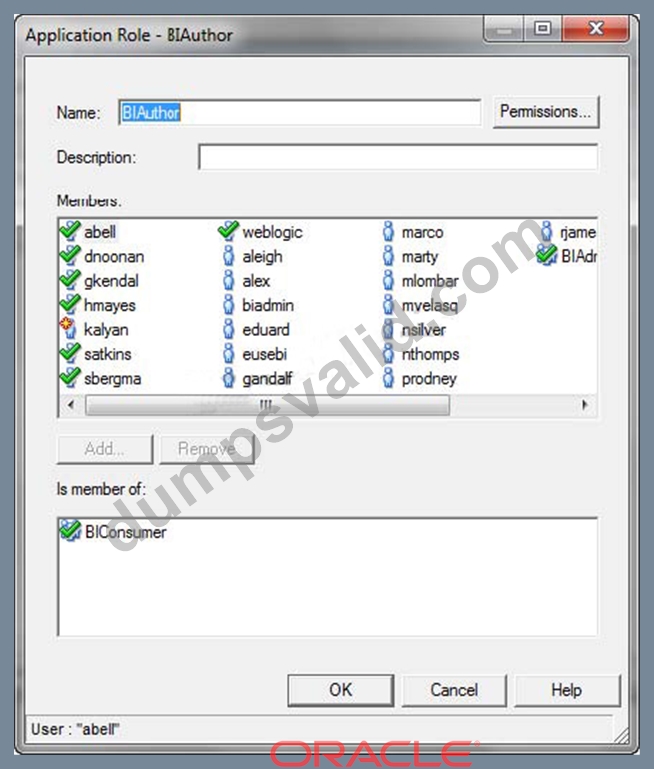
5. Set the Query Limits. You can limit queries by the number of rows received, by maximum run time, and by restricting to particular time periods. You can also allow or disallow direct database requests or the Populate privilege.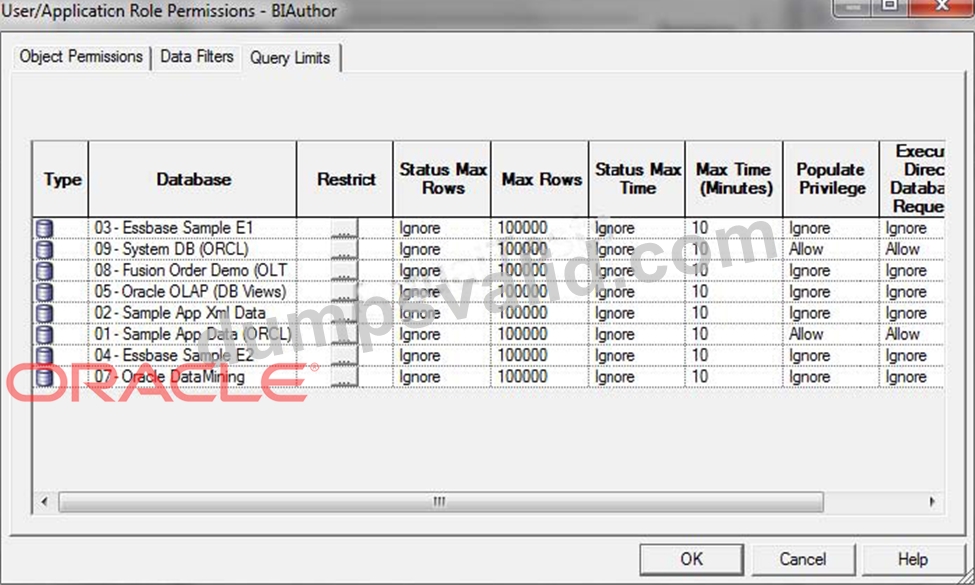
NEW QUESTION # 65
Point-and-click generation of case statement logic can be accessed via which option?
- A. Column Properties -> Conditional Format tab
- B. Advanced Tab
- C. Subject Area metrics
- D. Compound Layout
- E. Column Formula -> Bins tab
Answer: E
Explanation:
Explanation
The "Edit Column Formula" dialog box has a second,
very tiny tab called, "Bins." You can use this tab to have OBIEE
build a CASE statement for you in a formula (you can also create
a CASE statement yourself by using one of the functions that
appears under "Expressions" if you want). A CASE statement is a
lot like an IF-THEN-ELSE statement, except that it's a little easier
to read when you have multiple options. Basically, it puts values
in different buckets that you define.
Note:
Figure: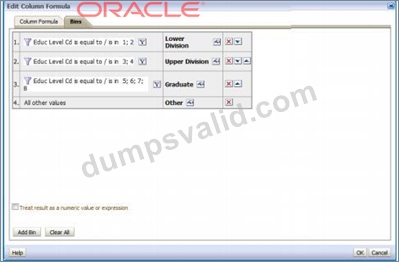
NEW QUESTION # 66
The Time Dimension hierarchy is a good example of a__________.
- A. Value-based Hierarchy
- B. Level-based Time Dimension hierarchy
- C. Skip Level Hierarchy
- D. Ragged Hierarchy
Answer: B
Explanation:
Level-based Hierarchy
Level-based hierarchy is the first type of hierarchy in OBIEE.
Consists of an ordered set of two or more levels. For example, a Time hierarchy might have three levels for Year, Quarter, and Month. Level-based hierarchies can also contain parent-child relationships.
Dimension hierarchy levels allow :
* to perform aggregate navigation,
* to configure level-based measure calculations,
* users from Dashboard and Answers to drill down from one parent to a child level.
Special type of level-based dimension are supported:
* Unbalanced (or ragged) and Skip-level hierarchy
* time dimension to provides special functionality for modeling time series data.
NEW QUESTION # 67
To add multiple sources to on existing logical table dimension in the Business Model and Mapping layer, the source of the data must first exist in which option?
- A. Physical Layer
- B. Web Catalog
- C. Presentation Layer
- D. Business Aggregate Layer
Answer: A
Explanation:
Explanation/Reference:
Note:
At the highest level, an OBIEE Metadata Repository includes three layers of information:
1. First, a Physical layer is defined. The metadata layer identifies the source data.
2.Second, a Business Model and Mapping layer is defined. This metadata layer organizes the physical layer into logical categories and records the appropriate metadata for access to the source data.
3.Finally, the Presentation layer is defined. This metadata layer exposes the business model entities for end-user access.
NEW QUESTION # 68
......
Passing Key To Getting 1Z1-591 Certified Exam Engine PDF: https://www.dumpsvalid.com/1z1-591-still-valid-exam.html
1Z1-591 Exam Dumps Pass with Updated Tests Dumps: https://drive.google.com/open?id=1a_Rl_npBN7zH268feY6-xZh9RXvgpWYX